
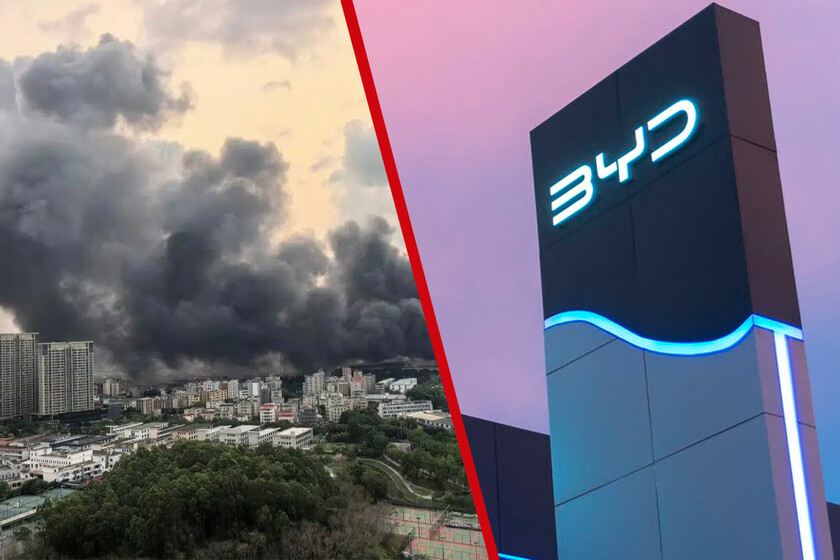
The striking images of a blaze at BYD’s global headquarters in China shocked social media on April 14, 2026, instantly reigniting the debate over electric car safety. However, far from the scenario of a battery thermal runaway that many feared, the explanation for this nocturnal fire proves to be quite different.
Thick columns of black smoke rose over the Pingshan district, while flames devoured the façade of a multi-story building. Dozens of fire trucks were deployed in the middle of the night, their emergency lights illuminating the scene.
Not Even BYD Is Immune to Zero Risk
Images of the blaze, verified by Reuters, spread quickly worldwide. The fire was reported at 2:48 a.m. in a multi-level parking garage located in the Ma Luan subdistrict, in the heart of BYD’s global campus, the world’s largest manufacturer of electric vehicles. More than 160 firefighters and 38 firefighting vehicles were mobilized to extinguish the flames. Fortunately, the blaze was brought under control without any casualties.
What did not cease were theories about the origin of the fire. Battery thermal runaway, design flaws, or even fraud. The speculation multiplied on Weibo and X. BYD firmly ruled out any connection to its technologies, asserting that neither the batteries nor the mass-produced vehicles showed safety issues or quality defects.
Moreover, what burned were not new cars destined for dealerships, but units taken out of circulation: test prototypes and end-of-life vehicles that the company stored in that parking lot in anticipation of their future dismantling and recycling. BYD was quick to state that assembly lines and production were not affected at any time.


You notice it from the very first time: switching to an electric car changes many things when it comes to driving. Beyond bidding farewell to unfounded preconceived ideas, you welcome a driving experience that is comfortable, simple, and relaxed. Those who have tried it know.
Brand-provided tip
The cause of the fire appears far more mundane. According to the preliminary report from the Pingshan District Emergency Management Bureau, collected by Sina Finance, the blaze originated from improper handling during the dismantling of obsolete equipment by an external construction company.
According to this version, the fire is said to have started from the use of insulating wool by a subcontractor. This material, highly flammable, would have ignited rapidly due to a worker’s negligence, though further details remain unknown. The fire, which at first seemed controllable, ended up breaking out and spreading quickly due to the presence of numerous cars with batteries.
Electric cars do not burn the same as combustion ones. When a lithium battery experiences uncontrolled overheating, the chemical reaction can raise the temperature to hundreds of degrees in seconds, spreading from one cell to another like dominoes. This process is known as “thermal propagation”.
During the fire, flammable gases are released that keep the flames active for hours, and even after they are extinguished, the risk of reignition remains high. This makes the firefighters’ task extremely difficult: to cool a battery pack, enormous amounts of water are required, and the area must stay under surveillance for at least a full day after the incident.
With the surge in electric vehicle production, ensuring safety in the storage, testing, and recycling of batteries has become a complex industrial challenge.