
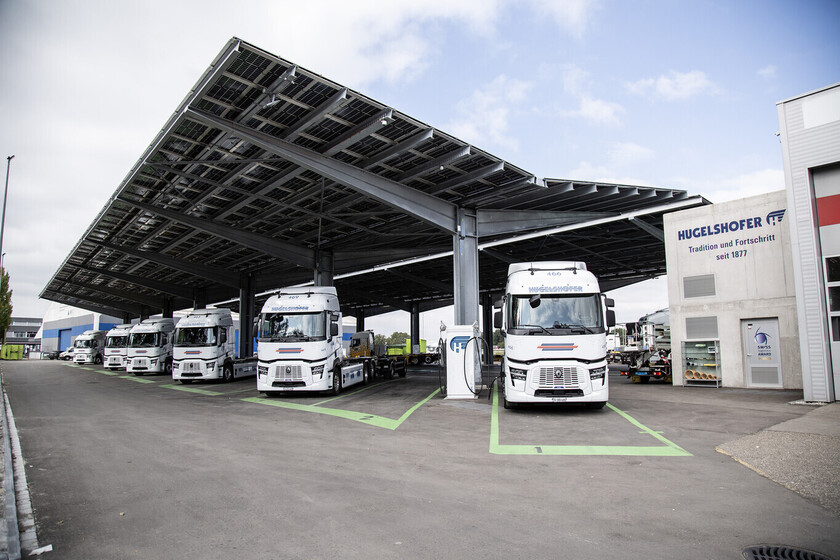
The electric truck had long been stuck in that limbo of “it’s coming.” Lots of talk, few units, and plenty of doubts. But 2026 is marking a change of pace in Europe: registrations of zero-emission heavy trucks grew strongly in 2025, and several consultancies already place the European market above 10,000 units per year between electric rigid trucks and tractor-trailers, still small compared with diesel, but already impossible to ignore.
And we’re not talking about a minor niche. Trucks and buses represent only a small portion of vehicles on European roads, but they generate around a quarter of road transport emissions, according to the European Commission. That’s why every truck that leaves diesel behind has a huge impact: replacing one can cut more CO2 than electrifying several passenger cars.
Brussels has made its position clear and has prioritized heavy transport, with new emission limits and a network of fast chargers along the continent’s major logistical corridors.
European manufacturers no longer compete for image: they compete for contracts
The benchmark among electric-truck manufacturers remains Volvo Trucks, which together with Renault Trucks dominates a large share of the European electric truck market. Its new generation promises up to 700 km of range for the FH Aero Electric, a figure that a couple of years ago would have sounded like science fiction.
Mercedes-Benz Trucks counters with the eActros 600, aimed at long-haul with around 500 km real-world range, while MAN Truck & Bus has begun the commercial push of its new electric tractor units and Scania is accelerating with models prepared for ultra-fast charging through MCS.

IVECO is also pushing hard in regional and urban distribution with its S-eWay range. The strategy is clear: start where electrification already pays off. Fixed routes, logistics centers, regional delivery, waste collection, or inter-facility transport. There the electric truck makes more economic sense today than on an international 1,500-km route without planning.
Why it is finally starting to add up for fleets
The main argument is no longer ecological but financial. Although buying an electric truck still costs significantly more than a diesel one, the cost per kilometer can fall with competitive electricity, lower maintenance and tax or toll advantages in some markets. Moreover, expensive and delicate components of modern diesel, such as complex anti-pollution systems (and AdBlue-related failures) or intensive maintenance, disappear.
There are real improvements for drivers as well: less noise, less vibration, and much easier driving. In an industry with chronic driver shortages, offering better conditions matters. For the end user, that could translate into more efficient supply chains and cities with less noise and lower local pollution.
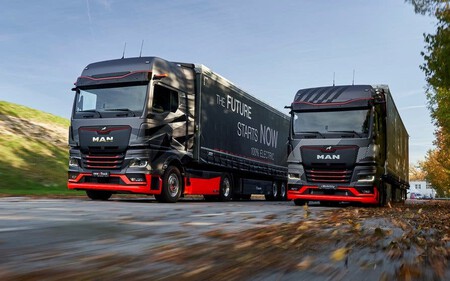
The big barrier remains fast charging and charging many at once
Autonomy is no longer the main problem. The real bottleneck lies in the infrastructure, because it is not enough to install chargers: ultra-fast charging points capable of delivering up to 1 MW of power are needed, designed to recharge large batteries in less than an hour.
Moreover, available power is needed in logistics areas, space to maneuver articulated sets, and rest-period-compliant times. This is where the European AFIR regulation comes in, which obliges the deployment of high-power points on the Trans-European Transport Network during this decade.
The other challenge is electrical, literally. Many industrial zones do not have immediate capacity to feed several tractor units charging at once. That requires investing in the grid, stationary batteries, and smart energy management. Without that invisible part, selling trucks is not enough.
Diesel hasn’t died, but it already has a strategic expiry date
Europe won’t rewrite millions of trucks overnight, but the real transformation has already begun: first will come the large fleets with optimized routes, then the rest of the market as prices fall and the charging network grows.
For now, diesel will continue to dominate for years, especially in long-haul and small fleets. But it won’t be forever. The electric truck has ceased to be a promise and has become a very serious threat to diesel’s reign.
Find your ideal electric car
If you’ve considered buying an electric car, this will interest you. We’ve created the personalized electric car recommender, where, in addition to seeing the models that fit your needs, you’ll also get answers to the questions that are most likely to worry you, such as price, range, or nearby charging points.