When at the Tokyo Motor Show of 1988 the first Suzuki Vitara was unveiled, surely the executives of the Japanese brand could not imagine that, decades later, that car would give rise to a 100% electric model for the entire world, the Suzuki e Vitara.
Built on the HEARTECH-e platform, the new Suzuki e Vitara also shares a lot with a Toyota model, the Urban Cruiser, which at the moment Toyota has no plans to market in Spain.
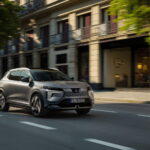
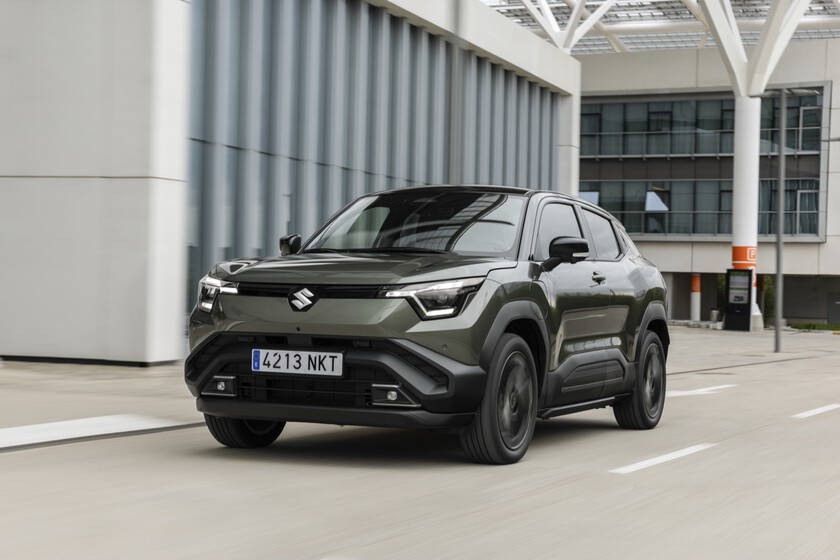
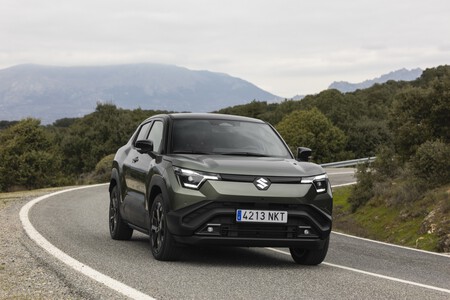
Measures 4.27 meters in length and is an urban SUV both in size and in approach. The final version now going on sale in Spain bears strong similarities to the prototype that previewed this model.

It is a car that, in terms of design, represents a considerable step forward compared with what Suzuki had shown up to now, featuring a more futuristic look, with broad lines and robust shapes.
The lighting forms part of the car’s hexagonal architecture, and both the front and the rear are distinguished by three-point matrix lighting signatures.
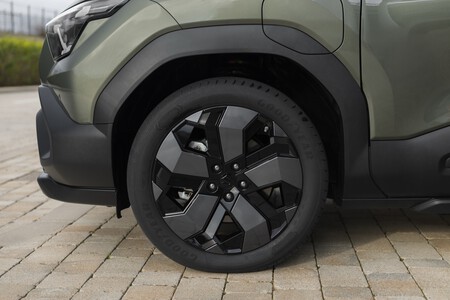
There are 18- or 19-inch wheels, much larger than those typically found on a Suzuki and always integrated into hexagonal wheel arches, which help reinforce its solid appearance.
As is the rule in this segment, the bodywork is available in two-tone paint options. Therefore, design-wise I believe this car is ready to take on rivals such as the Peugeot E-2008, the Opel Frontera Electric, the Ford Puma Gen-E, or the Hyundai Kona Electric, to name a few of its potential direct competitors.
It is a car that bears no design similarity with the rest of Suzuki’s lineup, but it can be identified as such thanks to a large S emblem on the front.
Interior very advanced
The cockpit of the car, like the interior, has little in common with what we are used to from the Japanese brand. We can say that it opens a new chapter in Suzuki’s history as a car manufacturer.
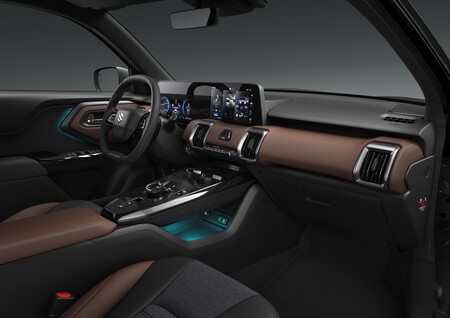
The interior is defined by two large 10″ screens, both integrated into a single black profile. The dashboard is upholstered in high-quality leather and offers comfortable padding and soft materials across most touchable surfaces.
To illustrate the leap forward this car represents compared with other Suzuki models we knew so far, it’s enough to say that it is the first Suzuki that can offer heated, two-spoke steering wheel with multifunction controls.
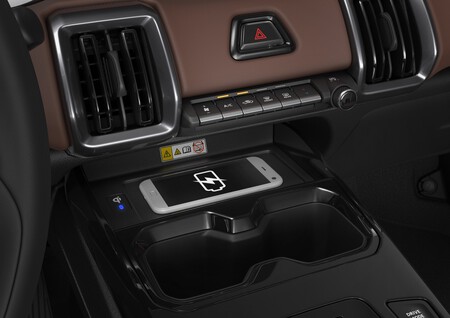
The space is good in the front seats considering the size of the car, and in the rear rows the sliding bench allows adjusting space when more trunk room or more room for the second row is needed.
Two battery levels and 4×4 or 4×2
The new Suzuki e VITARA is on sale with two lithium iron phosphate battery options, one of 49 kWh and another more capable at 61 kWh. Regarding the powertrain called eAxle, it comprises an electric motor, an inverter, and the transmission.
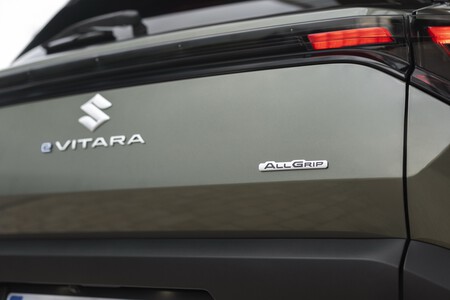
For the 4×4 versions, we are talking about two eAxles, one front and one rear, maintaining the AllGrip-e. The power levels of the 4×2 version are two, 144 and 174 HP, while the 4WD has 184 HP.
The ranges are 344 km for the 2WD with a 49 kWh battery, while the 2WD with a 61 kWh battery is rated at 426 km and the 4WD at 395 km.
The fastest available charging is 90 kW of power.
At the wheel of the Suzuki e Vitara
During the national launch presentation of the new model, which will begin to go on sale this very May in Spain, we had the opportunity to drive it around the outskirts of Madrid on a route that mainly ran along national roads in the Madrid mountains.
From the very first moment, the Suzuki e Vitara makes it clear that we are dealing with a car designed for everyday use with a predominantly urban focus, yet it is also very honest regarding its sensations. It does not seek to impress with astronomical figures, but to please with a progressive and perfectly dosed power delivery, ideal for urban traffic and suburban trips.
Although we could not drive it in the city, the immediate response of the electric system makes quick merges and agile moves between cars easier, while the smooth ride eliminates any vibration. Everything happens with a natural ease that invites relaxed driving, almost as if the car anticipates your intentions.
The steering, light in maneuvers, is particularly comfortable when parking or moving in tight spaces. However, it does not become artificial as the speed increases, maintaining a proper balance that conveys a certain confidence, though not as a sporty, communicative steering.
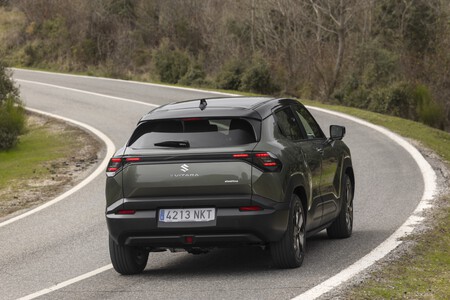
On highways, the e Vitara demonstrates a good capacity to maintain stable cruising. The soundproofing is well developed, with insulation that properly filters aerodynamic and road noise. It is not a premium car in this regard, but it is sufficiently refined for long journeys without fatigue.
When accelerating decisively, the power delivery is linear and steady. There is no harsh punch from more high-performance electrics, but it is not needed here. Everything is focused on efficiency and comfort, resulting in safe overtakes but without drama.
On secondary roads, the chassis stands out for its nobility. The suspension clearly prioritizes comfort, absorbing irregularities and potholes well, but without excessive body roll and you notice a bit of rear bounce when crossing some bumps, perhaps due to its short wheelbase.
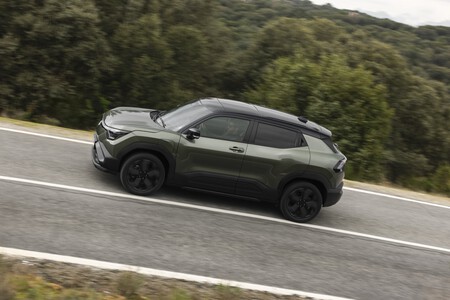
There is some body roll in corners, yes, but always progressive and controlled. This makes the car invite a smooth and steady pace rather than aggressive driving. It is one of those cars that “educates” you to drive better, exploiting inertia and anticipating braking to maximize energy efficiency.
The regenerative braking system plays an important role in this experience. It allows intuitive modulation of deceleration, enabling one-pedal driving if desired. It is not abrupt or artificial, and it integrates quite naturally into the whole.
As for the feel of the brake pedal, the transition between regenerative and mechanical braking is well resolved. There are no uncomfortable jumps or a sense of inconsistency, something that remains a weakness in many electric cars.
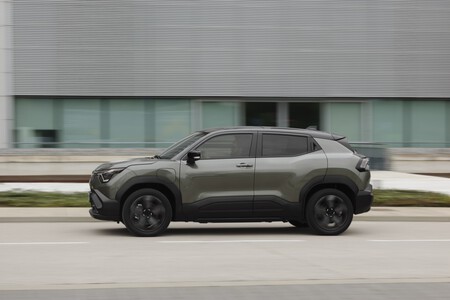
Another notable aspect is visibility. The raised driving position and the good glazing facilitate monitoring of the surroundings, key both in city driving and in maneuvers. It is a car that conveys safety from the first moment.
In terms of real-world range, energy management appears quite efficient. Without venturing into precise figures, there is a balance between performance and consumption that allows daily use without constant battery concerns.
Conclusions and prices for the Suzuki e Vitara
This is the range and the prices, both the MSRPs and the promotional campaigns and discounts applied to the Suzuki e Vitara.
|
MSRP |
Promo |
Auto Plan + |
MSRP with Auto Plan + |
|
|---|---|---|---|---|
|
S2 49 kW |
35.550€ |
3.500€ |
3.375€ |
28.675€ |
|
S2 61 kW |
40.050€ |
3.500€ |
3.375€ |
33.175€ |
|
S2 61 kW 4WD |
43.050€ |
3.500€ |
3.375€ |
36.175€ |
|
S3 61 kW |
42.850€ |
3.500€ |
3.375€ |
35.975€ |
|
S3 61 kW 4WD |
45.850€ |
3.500€ |
3.375€ |
38.975€ |
In short, the electric Suzuki e Vitara does not aim to reinvent the segment, but to offer a coherent, comfortable, and easy-to-digest experience. It convinces more by how it does things than by what it promises on paper, and that is where it truly gains value.
Suzuki is aware of this and does not intend to sell more than 300 units a year of a car that, as we said, is the first in a new era in which Suzuki does not intend to dominate the electric car segment, simply wanting to have in its range an option for customers who opt for electric car technology.