
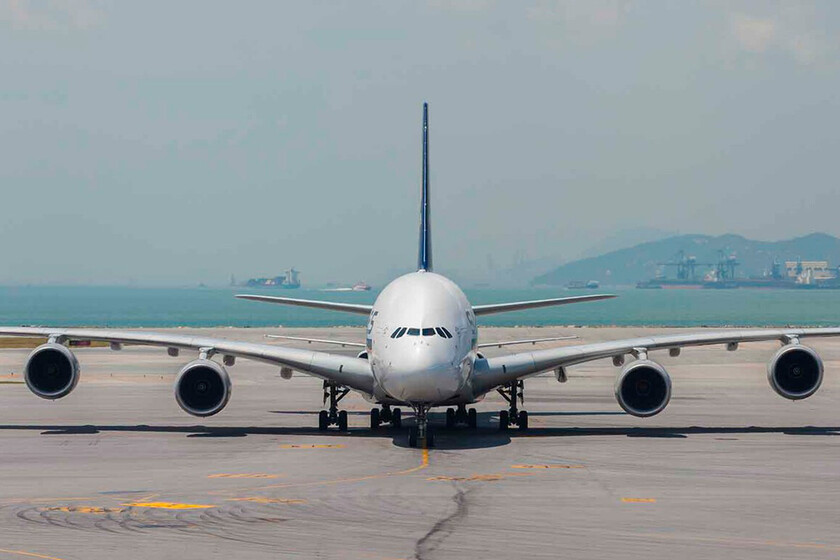
With two decks, 73 meters in length and nearly 80 meters of wingspan, the Airbus A380 is the largest commercial aircraft ever conceived. There is no other giant like it: it can carry between 500 and 550 passengers in a three-class configuration and up to 853 people in a single all-economy layout. Seeing it on the runway never fails to leave you with your jaw on the floor.
But this winged colossus has a major problem: it keeps breaking down. Its complexity has become a Damoclean sword, forcing it to be grounded with constant inspections and modifications. Which is fatal for airlines.
Too big, too many problems
A aircraft the size of the Airbus A380 is a complex machine: it is designed with about four million individual components manufactured by 1,500 companies from nearly 30 countries. Inside the fuselage there are about 19,000 bolts that connect each of the three main sections, its wings are joined by 4,000 bolts and it has 220 windows and 16 doors.
95 inspections and repairs in six years. With this mammoth tangle of components, the Airbus A380 records quite a few incidents. Since January 2020, the European Union Aviation Safety Agency (EASA) has issued around 95 airworthiness directives for the A380: nearly twice the number recorded in this period for large Boeing aircraft (787, 777 and 747).
These directives are, broadly speaking, inspections, corrections, and modifications. They must be performed on an aircraft or component to address potential safety issues, and they are mandatory. An airline faces penalties or the possible grounding of the aircraft if they are not complied with: you cannot allow a plane that could jeopardize the safety of hundreds of passengers to take off.
Among the problems detected in the Airbus A380 in these six years we find leaks in the evacuation slides, cracked seals, deteriorated gaskets, or even the failure of the landing gear. Incidents that largely have stemmed from aircraft parked during the pandemic.

A bottomless pit for airlines. Between maintenance and troubleshooting, an aircraft with such a high number of components and such technical complexity can require around 60,000 hours of work, Bloomberg reports via Lufthansa Technik. It isn’t that it sits idle for seven years: that figure reflects the total accumulated labor volume, with dozens of technicians working for days or even weeks.
This translates to the aircraft being grounded in the hangar for the necessary tasks. And when a plane isn’t operating it means high costs for airlines. Not only due to the space it occupies on the ground: not having it available implies delays, passenger rebooking, hotel expenses, compensation, and a complex reorganization of routes and crews.
If an airline operates a fleet with several of these Airbus A380s, the problem multiplies. Emirates is the airline that holds the largest number of units of this immense aircraft, currently 116 in total. Of these, almost 20 are usually parked either for maintenance work or as operating reserves.
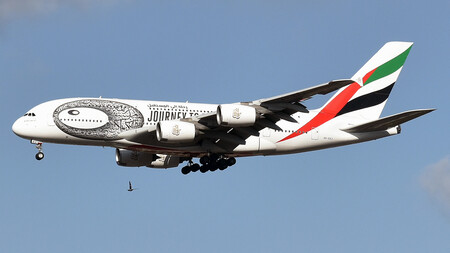
No substitute, for the moment. Emirates has therefore made a multi-million dollar investment in these giants, which it plans to keep using until the end of the next decade. But other airlines, such as Australian Qantas, Lufthansa, or Qatar Airways, intend to replace them with the Airbus A350 over the next ten years. It is smaller (depending on the version, between 300 and 400 passengers), but more fuel- and operating-cost-efficient.
And that is precisely the main issue: the Airbus A380, which ceased production in 2021 after 12 years of manufacture, has no direct substitute. Today there is no rival available of such size and capacity. The Boeing 777X is its natural competitor, but it is still under development following several delays, with airlines awaiting orders that are theoretically due to arrive this year. And Airbus cannot manufacture enough A350s to cover this long-haul capacity.
Images | Wikimedia