
Since 2022, China has been waging a battle less visible than the one over chips or electric cars: the one over food. With a population of 1,413.5 million people, according to the National Bureau of Statistics of China, guaranteeing abundant and affordable protein has become a national priority.
Fish is key to that equation, but its coastal waters are under pressure and dependence on imports is very high (especially for the species in greatest demand). Beijing’s response might seem ripped from a Netflix series, but nothing could be farther from the truth: megafishing ships that operate as mobile fish farms, instead of going out to fish, are designed to rear fish at sea.
These giants that defy the norms of traditional fishing are already in operation, and they are equipped among other things with smart sensors, automated feeding, and the ability to move to where the water offers better conditions for each species.
China shifts from fishing to “producing” fish in the middle of the ocean
One of the most striking projects is Wan Qu Ling Ding, built by Jiangmen Hangtong Shipbuilding. It measures 155.8 meters in length, has 12 independent compartments and can manage about 80,000 cubic meters of water. The managers of this megaship claim it can produce between 3,000 and 5,000 tons of high-value species per year such as seriola, grouper, or golden trevally.
The main difference between these megaships and traditional fish farms is that they do not stay fixed in one location. Instead of always operating in the same site, they can sail while maintaining the fish rearing in perfect conditions, controlled within their internal tanks and compartments.
Many of these tanks are semi-submerged or integrated into the hull itself to stay in contact with the exterior water. Thus, thanks to real-time monitoring systems, they can detect typhoons, episodes of pollution, red tides or abrupt temperature changes and move to safer or more favorable areas for the fish. Thus, aquaculture becomes a much more flexible operation, closer to a “floating logistics industry.”
Much more than fish: food security and industrial might
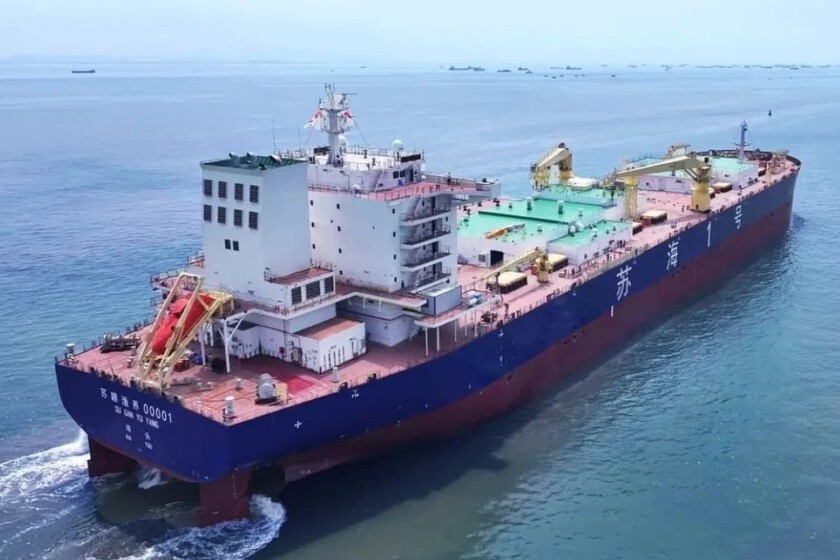
Another one of these ships worth mentioning is the Su Hai No. 1, a 250-meter leviathan designed to rear salmon. China imports a large portion of what it consumes, especially from Norway and Chile, so producing a portion within its own logistical radius reduces external dependence and shortens delivery times. In addition, it includes an onboard processing plant to send fresh product to major urban markets in less time.

With these ships China is not building mere floating farms; it is testing autonomous navigation technology, remote control, and energy efficiency that tomorrow could reach cargo ships, ferries or Ro-Ro vessels that transport cars.
In passing, it reduces pressure on fishing grounds and depends less on the outside world. Sometimes an industrial revolution does not begin in a factory or on a highway; it begins with a salmon fillet raised in the middle of the sea.
Images | CGTN Europe