
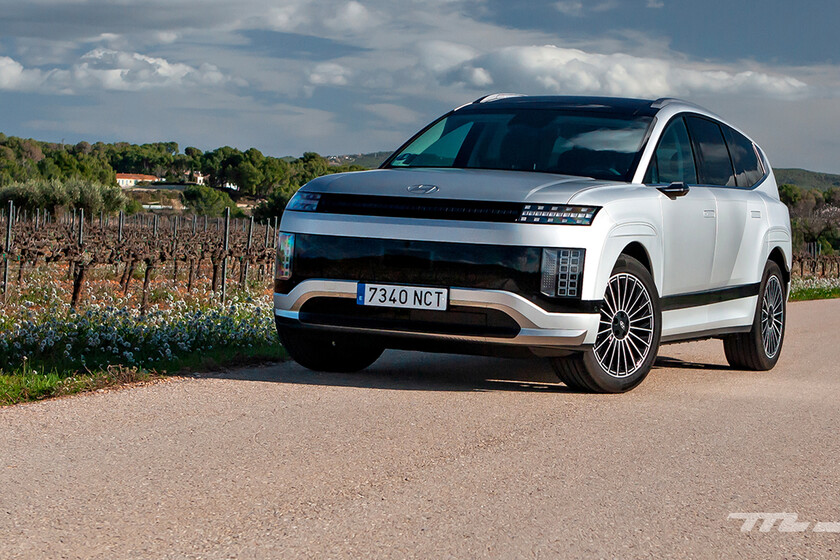
The Hyundai Ioniq 9 is the largest and most extravagant model in Hyundai’s increasingly complete electric lineup. From the small Inster to the confidential Ioniq 6 N, passing through the Ioniq 5 and Kona, the Korean brand has a model for every taste, need, and budget. The Hyundai Ioniq 9, for its part, ventures into a landscape where no one would have expected Hyundai to tread: luxury SUVs.
Designed for the North American market as something of an electric Range Rover in Korean guise, this enormous seven-seater, 5.08 m long by 1.98 m wide (excluding mirrors), tries to carve out a (small) niche on Europe’s narrow streets and roads.
Hyundai Ioniq 9, a Korean Range Rover
To enter a segment normally reserved for premium brands, the Ioniq 9 raises Hyundai’s usual standards of perceived quality. It shares the same technical base with its cousin the Kia EV9, namely the E-GMP platform with 800 V architecture and charging power up to 233 kW, which enables the 110.3 kWh battery to go from 10% to 80% in 24 minutes. If you happen to find a fast charger above 250 kW, you’ll be fortunate, as they are still scarce in Spain. Otherwise, you should expect a little over half an hour on a 150 kW unit.
All Ioniq 9 models come with the same 110.3 kWh battery and WLTP ranges spanning from 620 km to 600 km. The range starts at €69,900. It is equipped with a single motor (rear-wheel drive) delivering 218 hp for a WLTP range of 620 km. This is a lower-price variant, because all-wheel drive with a second motor raising power to 313 hp adds €11,700, bringing the price to €81,600.

On this occasion, we tested the next trim, the eCalligraphy (a nod to the legendary ‘Autobiography’ trim of Range Rovers) and top of the line. The all‑wheel drive version delivering 435 hp and its lavish equipment carry a price of €87,100. Above that, and for just €1,000 more, there’s a six-seat configuration available, with individual seats instead of two rear rows.
Cómo es conducir el Hyundai Ioniq 9
With 435 hp and 700 Nm of torque, the all‑wheel‑drive variant featured in the test demonstrates serious muscle. The car’s enormous weight—nearly 2.7 tonnes—disappears the moment you press the accelerator, delivering sprint times typical of a compact with sportier pretensions, with a 0-100 km/h time of 4.9 seconds and an 80-120 km/h time of 3.4 seconds.
And yet, it isn’t a dynamic-driven car. The substantial body roll in corners and during fairly brisk braking betrays the mass the chassis supports. The steering, thankfully, isn’t overly soft; it has just the right amount of heft to transmit confidence while remaining light enough to make the driving experience as smooth as possible.
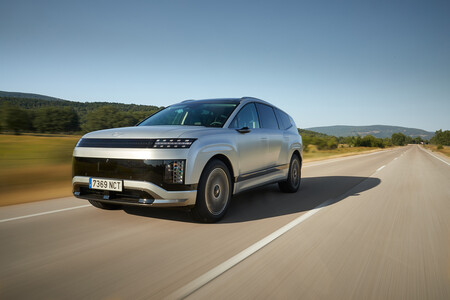
Brake pedal feels natural, smooth, and progressive. Regenerative braking features a five‑level system controlled by paddles on the steering wheel, ranging from coast to one‑pedal driving, including a very well‑tuned automatic mode that takes into account the road layout, intersections, and traffic. In short, the Ioniq 9 goes all in on comfort.
Espacio y comfort, el verdadero lujo del Ioniq 9
It’s the kind of car you step out of after 400 km feeling as relaxed as if you’d simply gone to the corner of your street. The seats are incredibly comfortable. Up front, they even offer adjustable lateral supports via air cushions and a leg rest for added relaxation.
Behind, and thanks to a 3.13‑meter wheelbase, the second row offers exceptional space; it’s like traveling in a living room. Even the third row is comfortably usable by adults, which is rare in this kind of vehicle. Access is straightforward: a button on the second-row seats clears the way to the rear, and all backrests fold using buttons located in the boot.
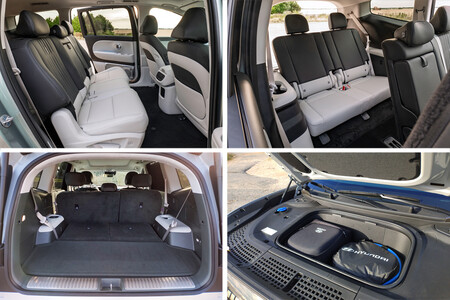
A cargo de un maletero que puede convertirse en una auténtica bodega. En la configuración de siete plazas, ofrece un volumen razonable de 338 litros; en la configuración de cinco plazas, libera 908 litros, que aumentan a 2.419 litros al abatir las dos filas de asientos. En cuanto a practicidad, destaca la consola central deslizante de 19 cm, la guantera central que se abre por ambos lados, los amplios compartimentos de almacenamiento, los numerosos y potentes puertos USB, y el maletero delantero de 52 litros, suficiente para guardar todos los cables y el kit antipinchazos.
Pero la comodidad del coche no se limita a maletas y asientos. La suspensión multibrazo en both ejes y los amortiguadores de doble válvula del Ioniq 9, con una puesta a punto exquisita para el confort, lo convierten en una suerte de alfombra volante. Su carta de presentación más destacada es, sin duda, lo refinado de su viaje. La cancelación activa de ruido, el doble acristalamiento y esos neumáticos de flancos altos (perfil 45) a pesar de las llantas de 21 pulgadas, también ayudan a que viajar en el Ioniq 9 sea una experiencia excepcionalmente serena.
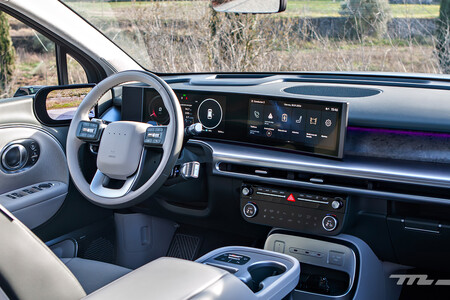
And that’s even in the city. Despite its size for our streets, it’s very easy to drive. The turning circle is tight, and its relatively square shape with minimal overhangs makes it easy to keep in mind its dimensions for navigating narrow streets and even parking. The presence of small camera mirrors instead of large traditional mirrors also helps ease of driving.
And what about range and efficiency?
The enormous dimensions of the Ioniq 9 come with advantages and drawbacks. Among the drawbacks is the weight. The battery alone weighs 625 kg, contributing to a total mass close to 2.7 tonnes. During the test—over 500+ km spread across a week with a mix of routes and urban driving—it returned an average of 23.3 kWh/100 km.
On the highway, with speed limits respected, the average rose to 25.5 kWh/100 km. Far from the 600 km WLTP average, that reduces real-world range to about 430 km at most (three people aboard, no luggage). Between 10% and 80% charged, it offers about 302 km of range. A figure that places the Ioniq 9 among the electric cars with the highest range on the market.
And is it expensive? For its segment, no
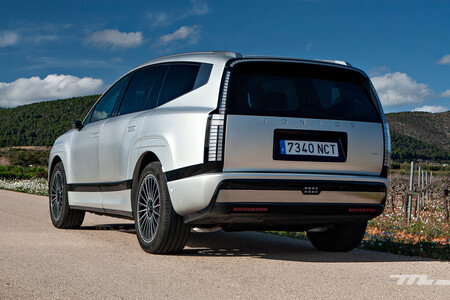
The Ioniq 9 starts at €69,900 with a highly comprehensive and tech‑savvy standard equipment list. In contrast, the eCalligraphy version shown here, with 428 hp, camera mirrors, and more exclusive finishes, starts at €87,100.
The standard equipment is so complete (driving aids, semi‑autonomous lane change, 360° cameras, heated and ventilated seats, BOSE audio, panoramic sunroof, etc.) that the only options are metallic or matte paint. In this case, with the Matte Golden Gray paint priced at €1,500, the final bill comes to €88,600. Currently, financed through the brand, there is a discount of €8,510, bringing this Ioniq 9 down to €80,090.
There are few electric alternatives to the Hyundai Ioniq 9. Of course, its cousin the Kia EV9 starts at €85,165 with a 99.8 kWh battery. The Ioniq 9 exceeds it in both range and interior space.
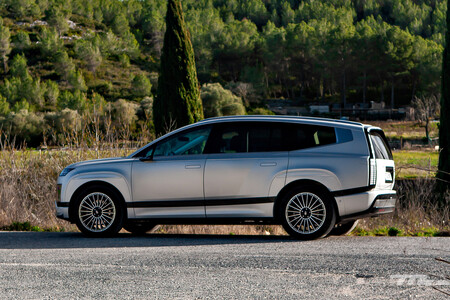
Another option would be the Volvo EX90 (5.04 m), from €83,900, with a higher level of luxury and price tags easily surpassing €100,000 as power and equipment increase. It also offers higher charging power. It’s the only model capable of truly challenging the Ioniq 9. As for the Mercedes EQS SUV (5.13 m), it operates in a completely different price tier, starting at €140,286, with the optional third row costing €2,200.
Hyundai Ioniq 9: our assessment
8.0
8
9
8
8
9
7
8
7
9
7
Pros
- Comfort and ride quality
- Generous interior room
- Range thanks to the enormous battery
- Strong charging capability
Cons
- Consumption could be improved
- Chassis not particularly dynamic
Among electric cars in this caliber, the Ioniq 9 offers the most cabin space and is best suited for long trips with several passengers. It’s extremely comfortable and drives surprisingly well for its size. Regardless of the seat, the experience is quiet and luxurious.
However, its credible range hinges more on the massive battery than on efficiency. At least, its prices, high for Hyundai, are competitive against more exclusive rivals, while build quality reflects that mid-position between mainstream and luxury.
|
|
|
|
Powertrain |
Two electric motors, one on each axle. |
|
Battery |
Lithium‑ion. 110.3 kWh |
|
Peak power |
435 HP |
|
Max torque |
700 Nm |
|
Drivetrain |
All‑wheel drive |
|
Dimensions (L x W x H) |
5,060 x 1,980 x 1,790 mm |
|
Wheelbase |
3,130 mm |
|
Boot space |
Seven seats: 338 liters. Five seats: 908 liters. |
|
Weight |
2,689 kg |
|
80-120 km/h |
3.4 s |
|
0-100 km/h |
4.9 s |
|
Top speed |
200 km/h |
|
WLTP combined consumption |
20.6 kWh/100 km |
|
Average tested consumption |
23.3 kWh/100 km (Highway: 25.5) |
|
Max WLTP range |
600 km |
|
Tested range |
473 km (Highway: 430) |
|
Prices |
From €69,900. Test unit: €88,600 |
Find your ideal electric car
If you’ve contemplated buying an electric car, this will interest you. We have created the Personalized Electric Car Recommender, where, in addition to seeing models that fit your needs, you’ll also get answers to the questions you’re most likely to worry about, such as price, range, and nearby charging points.
|
The car used for this test was provided by Hyundai. For more information, please consult our Corporate Relationships guide. |