
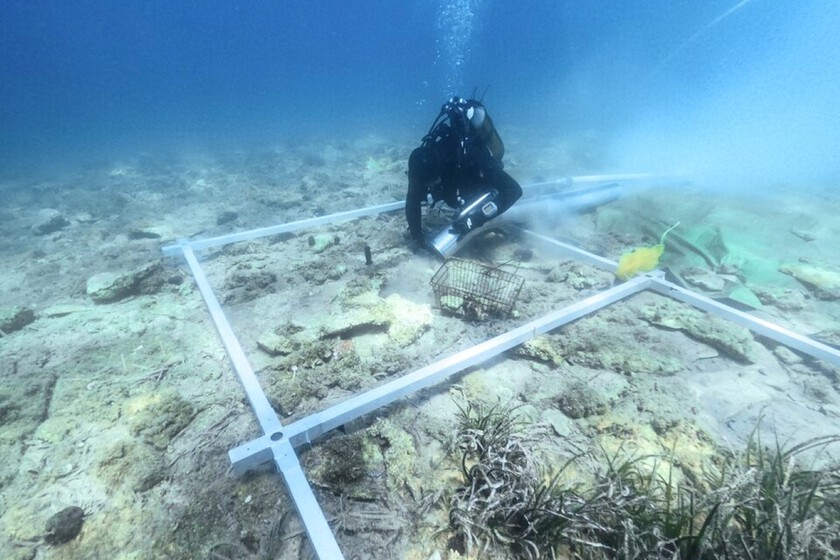
Thousands of years ago, where today the vast blue waters of the Adriatic shine off the coast of Croatia and sightseeing boats sail, there were people walking along a stone road that was essential to their daily life. It is a kind of prehistoric highway that was submerged about 7,000 years ago near Korčula, one of the country’s best-known islands.
The discovery by archaeologists from the University of Zadar initially appeared to be a simple anomaly in aerial and satellite images. But it ended up revealing a sophisticated infrastructure for its time, formed by stone slabs laid meticulously, creating a road about four meters wide that connected a settlement with the ancient shoreline.
A Neolithic Highway That Still Tells How Its Builders Lived
As explained by archaeologist Mate Parica when presenting the find, the road connected a settlement belonging to the so-called Hvar culture, a Neolithic society established on the eastern Adriatic coast between the 5th and 4th millennia BCE. They were agricultural and seafaring communities that already worked stone, wood, and pottery, and knew how to organize stable spaces for living and trading.
Radiocarbon dating performed on wood remains recovered in the area (a scientific technique that allows determining the age of organic materials) places the complex around 4900 BCE. That means this road already existed centuries before Stonehenge and thousands of years before the great Roman imperial roads. Its construction could not have been improvised: it required planning, collective work, and a solid knowledge of the terrain.
But why is it underwater today? The answer lies in the end of the last Ice Age. As time passed, enormous masses of ice melted and sea level began to advance gradually. Many coastal areas ended up submerged and ancient settlements were buried under the water, as in this case. Thus, the Korčula road was frozen in time as evidence of that great geographic change.
Other factors helped its good conservation, such as the proximity of other islands, which dampened the waves and protected the structure from the more aggressive erosion. Underwater archaeologists work there with dives, 3D photogrammetry, digital cartography, and very slow excavations to avoid altering sediments that have remained intact for thousands of years.
A World of Life Waiting to Be Discovered Beneath the Sea
Although the Mediterranean has given us other submerged sites of enormous value, finding a stone road as ancient and well preserved as this remains quite unusual in Europe.

For example, in Gradina Bay (on the other side of the island), an underwater settlement with stone tools, axes, and everyday objects was found. Also notable are sites such as the ancient Pavlopetri off the coast of Greece, or port remains located in Alexandria and Italy… or sunken cities like Baiae in Italy.
Today Korčula thrives on tourism, its beaches, and its medieval old town. But beneath its waters lies another, much older attraction: a road built when Europe was just beginning to establish stable settlements and connect communities. Some of the earliest great human works remain down there, hidden beneath the sea.
Images | Official University of Zadar