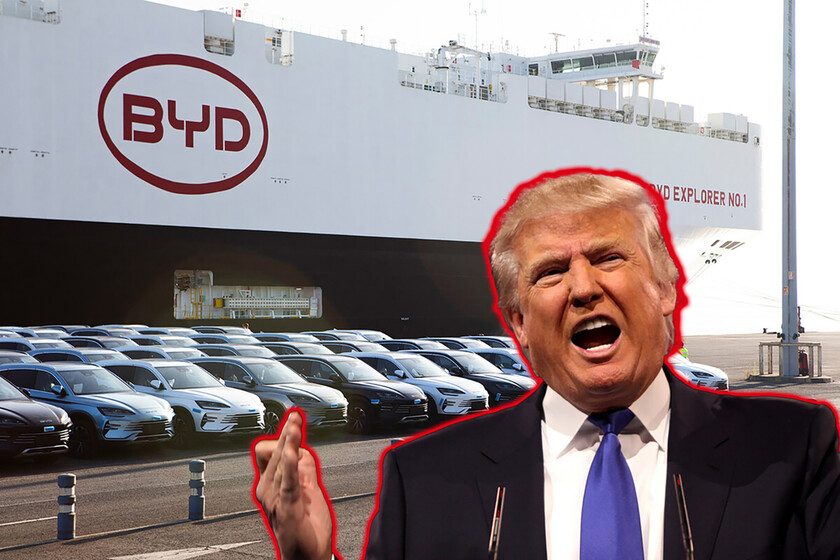
Canada and China reached a trade agreement earlier this year that will allow Chinese brands to sell their cars in the North American country. The United States’ response did not take long.
The Secretary of Transportation, Sean Duffy, spoke from a Ford factory in Ohio, where he was taking part in an event promoting the American industry. His words were blunt: “You will regret this decision and lament having allowed Chinese cars into your market”
BYD, Geely and CHery (Jaecoo and Omoda) will be the first to arrive
The stance from Washington also echoes within Canada itself. Doug Ford, Ontario’s premier and one of the most vocal critics of the agreement, warned that easing tariff barriers for Chinese electric vehicles could have consequences for Canadian car exports to the United States, its most important trading destination. A risk not negligible, especially at a time when those exports already face a 25% tariff imposed by the Trump administration.
More concretely, the agreement will take effect from 2027, and will allow up to 49,000 vehicles manufactured in China to enter Canada with a preferential tariff of 6.1%, a level that, according to Canadian Prime Minister Mark Carney, is equivalent to what existed before the additional 100% tariffs adopted in 2024.
As for brands, BYD, Geely and Chery, the owner of Jaecoo and Omoda, will be the first to establish a footprint in Canada. The U.S. will thus be surrounded by countries where Chinese cars are sold. And that has not pleased the Donald Trump administration.

Although the trade agreement opens the door to importing Chinese electric and plug-in hybrid cars, Canada does not fling its doors completely open. The agreement sets an annual import cap that will ramp up to 49,000 cars by 2030, and half of them must be priced under 35,000 Canadian dollars, about 21,600 euros at the current exchange rate.
Additionally, the number of vehicles priced under 35,001 Canadian dollars must represent 10% of the Chinese electric cars imported in 2027. Subsequently, this proportion will rise to 20% in 2028, 35% in 2029, and 50% in 2030.

When a few years ago people wanted to show off a car, the focus was usually on low consumption, power, or extras. Now, not so much. Technology has taken center stage. But it isn’t always where we expect it to be, appearing in places far less obvious.
Advice offered by the brand
This last requirement has a very clear takeaway: these are affordable cars, a segment where practically no Western, Japanese, or Korean brand currently has a real presence. China, by contrast, offers a wide and competitive lineup in that price range.
To gauge the real impact of these figures, one data point is enough: in 2025 Canada sold about 1.9 million vehicles, of which around 250,000 were electric or plug-in hybrids. With that backdrop, the 49,000 Chinese vehicles would represent less than 3% of the total market.
In any case, according to DSMA, an automotive intelligence and mergers-and-acquisitions advisory firm, several Chinese brands are already actively working to obtain homologation, set up a distribution network through agreements with dealer groups, and find local financing partners, according to Automotive News Canada reported on Tuesday. Among those brands with much of the groundwork already done are Geely, via its brands Polestar, Volvo, Lynk & Co and Zeekr, and the Chery group, via its brands Jaecoo and Omoda.
As for BYD, it already even has Transport Canada’s approval to sell vehicles there. And that is because before the 100% tariffs imposed by the previous government, BYD had already begun the process to export to Canada.
Find Your Ideal Electric Car
If you’ve been considering buying an electric car, this will interest you. We have created the Personalized Electric Car Recommender, in which, in addition to viewing models that fit your needs, you’ll also get answers to the questions you’re most likely to worry about, such as price, range, or nearby charging points.