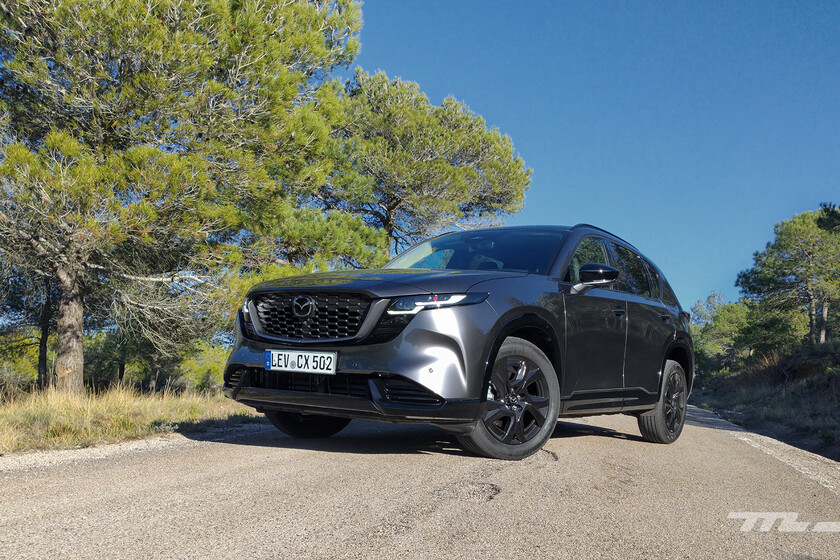
There are things you can always count on. The taxman will catch you, the league will be won by Barça or Real Madrid, and the Mazda CX-5 remains, through generations, the family SUV with a chassis that pleases its passengers with comfort and the driver with its dynamism. But more importantly, it has matured significantly in its design, practicality, and safety, and it is cheaper than ever. In fact, the new Mazda CX-5 is cheaper than the outgoing model despite being larger and more well-equipped.
We headed to Tarragona to test this new generation of the Mazda CX-5, the brand’s best-selling model, now bigger, more tech-forward, more premium, and now cheaper than ever.
How the Mazda CX-5 has grown
For more than a decade, Mazda positioned itself as a brand whose core philosophy was to make cars fun to drive, with the MX-5 roadster as its prime example. Mazda has largely moved away from that message in its current communications, although, overall, its cars still feel sportier than rivals. Yet some of that magic has faded in the new CX-5. A model that is now available, with a single 141 hp petrol engine and ECO badge, in front-wheel drive or all-wheel drive.
The new CX-5 is longer than the previous generation (by 11.5 cm, bringing the overall length to 4.69 m). Most of that extra length comes from a longer wheelbase. And this results in rear seats that are significantly more spacious, with wider door openings (the rear doors open to almost 90 degrees) and a larger boot capacity.


The Mazda CX-5 is, above all, a family car, and it has not always offered the most generous rear-seat space. Yet, now that it gains 11.5 cm in length, the CX-5 completely reshapes the on-board experience. The driver immediately enjoys a comfortable position, with broad seat adjustments to fit occupants of any height, even the tallest. The panoramic sunroof, available on higher trims, does not eat into headroom, avoiding that claustrophobic feel.
Nevertheless, the improvement is most noticeable in the rear seats. Thanks to the longer wheelbase, rear passengers enjoy generous legroom and can move more comfortably.
The boot also benefits from this redesign. With a wider tailgate and a lower load floor, the boot capacity increases from 506 liters in the previous model to 583 liters.
Touchscreen and premium finishes

On the technology front, Mazda takes a step forward by ditching the traditional rotary dial used to control the central screen. While this system persisted in earlier models, the CX-5 2026 adopts a fully touch-based interface for all functions. It features Google built-in, so the most-used Google apps are available from the start. You can also download, among others, Spotify, Waze, or Netflix, and Google Maps becomes the default navigation system.
The standard versions come with a 12.9-inch display, while the range-topping Homura adds an impressive 15.6-inch touchscreen, delivering a more contemporary experience, though not necessarily the most ergonomic one.
In any case, the dual-zone climate controls, which are the most used via the screen, have a relatively large touch area. Temperature adjustment is done simply by sliding your finger to the right for warmer or to the left for cooler. Among the few ergonomic issues with touchscreen systems, this is a fairly well-executed interface.

Additionally, the multifunction steering wheel features tactile buttons that allow you to control the ADAS driving aids and the audio. They’re noticeably better executed than those on Volkswagen, being easy to use and not prone to accidental presses.
Finally, the interior plastics and build quality deserve note. While there are a few hard plastics, the CX-5’s cabin feels genuinely premium, on par with, or even superior to, some German premium brands.
The result is an SUV that not only grows in size but also in functionality and comfort, establishing itself as a more versatile option tailored to the needs of its occupants.
When it comes to style, Mazda sticks with continuity. There’s no need to break with the previous generation with every model, as Hyundai or Kia sometimes do. Especially because Mazda has a winning design formula that has delighted since the model’s 2012 debut.

More than five million units sold since then, of which over 850,000 were in Europe. In any case, the new headlights and taillights give a more modern and luxurious touch to the whole, but just by looking at it you can tell it’s a CX-5.
Mazda CX-5: more family-oriented and less sporty
Under the hood, the 2.5-liter naturally aspirated engine returns with little in the way of changes. It remains a mild-hybrid—and therefore with an ECO badge—producing 141 hp and 238 Nm of torque at 3,500 rpm. It is also paired with a six-speed gearbox. A mechanical combination that is proven and reliable, but not the most efficient in terms of fuel consumption.
After a brief test, roughly 200 km of highway, mountain roads, and urban driving, the average consumption came in at 8.4 L/100 km. It’s possible to drop below 7 L/100 km with relaxed highway cruising, but you must be very easy on the accelerator.

Desafortunadamente, sigue siendo un motor bastante ruidoso al acelerar para un 0 a 100 km/h en 10,5 segundos (casi 11 segundos con tracción total). Mucho ruido para poca aceleración. Además, esa impresión se intensifica por una caja de cambios lenta al reducir marchas para volver a acelerar.
Con todo, Mazda ha trabajado en la insonorización del CX-5 para mejorar el confort y reducir el ruido de rodadura. Un esfuerzo con relativo éxito, ya que el murmullo del asfalto puede hacerse notar en pavimentos más ruidosos.
Donde sí Mazda ha hecho un trabajo excelente es en la suspensión. Aclaremos de inicio que el coche es realmente cómodo y suave, pero a la vez tiene una pisada firme. Han sabido combinar la comodidad para los pasajeros y la firmeza para no perder ese toque deportivo tan característico de Mazda.
Ahora, el CX-5 ofrece ese comportamiento de conducción relajado que encaja con la sensación de “una alternativa viable a los coches premium” que Mazda ha buscado en los últimos años.

Sadly, it seems that this refinement has come at the expense of Mazda’s essential identity. On the winding roads of Priorat, the new CX-5 isn’t as fun to drive as the previous generation. While it remains one of the SUV contenders with the best on-road behavior, the front end no longer attacks corners with the same determination as the outgoing model.
Finally, the excellent tuning of the ADAS driving aids deserves mention, as they are hardly intrusive. The lane-keeping assistant operates in the background without you noticing, unlike some Korean, Chinese, or Audi systems where continuous steering interventions seem to be the norm.
In Mazda’s implementation, the car nudges the trajectory when needed, applying just the right amount of steering force so you hardly notice. A positive point also goes to the brake assist that slows the car if you get too close to the vehicle ahead, and it does so without slamming on the brakes 20 meters beforehand, as many rivals do.
Prices and Alternatives to the Mazda CX-5

The 2026 CX-5 starts at 35,200 euros. That’s 2,383 euros less than the old CX-5 2.0 MHEV with a 6-speed automatic and it includes more standard equipment. Compared with premium rivals, such as the Audi Q3 TFSi 150 hp S-tronic, the CX-5 MHEV is more than 10,000 euros cheaper. The Q3 does offer a better engine, with more power and lower consumption, plus the badge. For everything else, Mazda’s proposition is stronger and more relevant.
Compared with semi-premium options, such as the Honda ZR-V, Mazda remains around 5,000 euros cheaper. That said, the Honda is more powerful, has lower fuel use, and comes with equally complete standard equipment. Another rival, the Renault Austral with 150 hp, costs the same but falls short in terms of driving enjoyment and finishes, which, while not poor, don’t have the same luxury feel as the CX-5.
There are cheaper options, like the MG HS Hybrid+. It’s larger, presents well, and at the same time is more powerful (224 hp) with lower consumption, starting from 32,840 euros.
To stay price-competitive, the CX-5’s entry Prime Line trim benefits from a launch discount of 4,205 euros, bringing the new CX-5 to 30,995 euros. It’s cheaper than the MG, for example. It’s hard to find a model with a better price-quality-equipment-reliability balance (up to 10 years of warranty) on the market.
MAZDA CX-5 2026 PRICES
|
Finishes |
|
|---|---|
|
PRIME-LINE |
35.200 € |
|
CENTRE-LINE |
37.200 € |
|
CENTRE-LINE AWD |
39.200 € |
|
EXCLUSIVE-LINE |
38.700 € |
|
EXCLUSIVE-LINE AWD |
40.700 € |
|
HOMURA |
41.480 € |
|
HOMURA AWD |
43.480 € |
The Mazda proposition may surprise with a single engine option, which is a cost on fuel consumption. However, this powertrain won’t stay solitary for long. In 2027, a full-hybrid version will arrive. Developed by Mazda, at first it has nothing to do with Toyota’s RAV4 drivetrain.
In the end, it’s hard to criticize Mazda for giving the CX-5 a more family-oriented and broadly appealing focus. The customers asked for more space, a touchscreen infotainment system, and probably a bit more comfort. Mazda has delivered on those requests and, what’s more, managed to do so without unnecessarily inflating the price, which is commendable.
Expenses associated with attending this presentation have been covered by the brand. For more information, please consult our corporate relationships guide.