
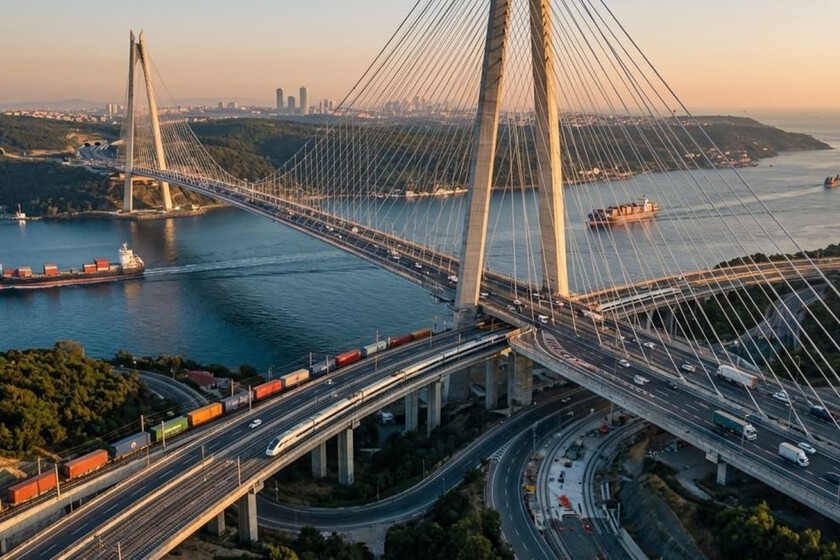
Istanbul has always been more than a city: it has long been a crossroads for trade between Europe and Asia. The problem is that this connection, in the 21st century, still largely depends on saturated roads and on a railway tunnel that has already grown too small.
Turkey intends to change that with a gigantic infrastructure project: a 125-kilometer railway line that will not only unite the two continents but also connect its two major airports, as Reuters notes. A strategic undertaking that aims to become a cornerstone of global transport.
The train that could turn Istanbul into the world’s great logistics bridge
The so-called Northern Ring Railway will run along the northern part of Istanbul from Halkalı (European side) to Gebze (Asian side), crossing the Bosporus Strait via the Yavuz Sultan Selim Bridge. In addition to moving passengers, this mixed-use infrastructure is designed to carry heavy freight trains.
The project, in figures, is colossal: according to the Turkish Ministry of Transport, the line could carry up to 33 million passengers and 30 million tonnes of cargo per year. To put this into perspective, the current Marmaray rail tunnel has moved barely 1.7 million tonnes between 2020 and 2025, and only during limited hours.

When completed, the project will for the first time connect the city’s two major international airports, Istanbul Airport and Sabiha Gökçen, something that in other large capitals is already standard for air logistics. Here, until now, it had been a pending task.
A colossal undertaking… and riddled with technical, environmental, and economic obstacles
The total cost of this colossal project is estimated at more than 8 billion dollars and already has preliminary financing agreements for 6.75 billion coming from major international bodies such as the World Bank or the European Bank for Reconstruction and Development. According to statements to local media by Minister Abdulkadir Uraloğlu, the goal is to begin construction before the end of this year.
It won’t be easy, because more than 65% of the route runs through tunnels and over bridges, with about 60 km underground and more than 20 km on viaducts. The north of Istanbul is thus a complex area, with hills, valleys, and high seismic activity due to its proximity to the North Anatolian Fault. In this sense, one must not forget the environmental impact of such a project.
View this post on Instagram
Nolan Kessler
I focus on performance-driven cars, emerging technologies, and the business forces shaping the automotive industry. My work aims to deliver clear, relevant insights without unnecessary noise, with a strong attention to detail and accuracy. I follow the evolution of mobility daily, with a particular interest in what defines the next generation of driving.