
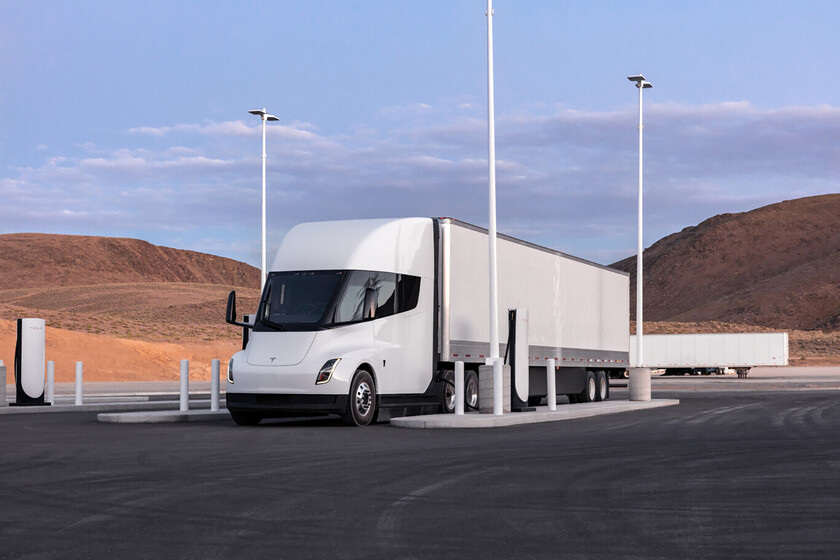
Tesla unveiled the Semi, its electric tractor for semi-trailers, for the first time in 2017, with Elon Musk claiming the truck’s windshield could withstand a nuclear blast and that production would start in 2019. By the end of 2022, Tesla held a delivery event and handed the first units to PepsiCo, but three years later the vehicle remains far from reality.
This summer, after years of delays, Tesla plans to begin delivering the first mass-produced Tesla Semis at its Nevada Gigafactory. According to a recent report by Tigress Financial Partners, the company is expected to deliver between 5,000 and 15,000 Semis in 2026.
Fascinated with the Tesla Semi, but still in pilot testing
Almost ten years ago, Tesla introduced the Semi as a pending revolution in freight transport, following the success of the Model 3, which democratized the use of electric cars. However, the company has redirected its priorities toward areas such as artificial intelligence, robotics, and the Cybercab robotaxis, partially leaving behind its initial bet. And now, it aims to manufacture semiconductors at a pace that would be impossible to feed the AI data centers.
Meanwhile, the U.S. market has swung back toward fossil fuels. The removal of incentives for buying electric vehicles and the loosening of emission standards during this administration have slowed the push toward electrification in the sector.

Currently, the Semi remains in pilot trials. These trials, surprisingly for a workforce that is traditionally conservative like U.S. truckers, are winning over transportation professionals. Not so much because it is a disruptive truck, but because it is delivering what local manufacturers have long refused to offer drivers and trucking companies, such as ease of driving and ease of maintenance.
A 56-year-old driver, Ángel Rodríguez, who works for Hight Logistics in Long Beach, California, recently tested the Semi for a month, swapping his 13-speed diesel tractor for this automatic model. “It is physically much more comfortable,” Rodríguez explained. “It reduces stress since you don’t have to worry about the clutch or the gear changes,” he told the Wall Street Journal.
Another driver, Dakota Shearer, from IMC Logistics, found himself stuck in a tight curve with a 12-meter trailer in a small Nevada town. With a regular diesel truck, he would have had to disembark repeatedly to check angles, he says, but with the Semi, one single maneuver sufficed.

Automatic gear shifts, cameras and proximity sensors that ease driving are relatively common in European trucks, and for American drivers it’s pure science fiction, as Bruce Wilson repeatedly demonstrates on a U.S. tour to promote Scania, a brand eyeing the U.S. market with a model from its European range.
Some logistics companies in the Los Angeles and Long Beach area, two of the busiest ports in the U.S., consider the 500-mile (680 km) range Tesla has announced to be enough for their operations and view the electric nature as a huge saving in terms of personnel and maintenance.
Big F Transport, for example, has five mechanics to maintain more than 40 diesel trucks in Wilmington, California. “If we switch to fully electric vehicles, we’ll only need one mechanic,” said Geovanny Meléndez, the company’s vice president of operations, to the financial newspaper.
Everything seems perfect, according to those who have tested the trucks in pilot trials. However, deliveries have yet to occur, and at least two major hurdles remain if Tesla truly intends to manufacture and sell trucks.
The charging infrastructure isn’t ready. Construction of Megachargers for the Tesla Semi at selected locations is slated to begin in the first half of 2026, with the first stations expected to open in the summer of 2026. You can’t sell a long-haul truck on a large scale without a charging network to back it up.
Price uncertainty. This is undoubtedly the biggest mystery. Tesla never updated its original prices, ranging from $150,000 to $180,000 depending on the battery, and a “drastic” price increase is believed to have occurred.
Data from California’s electric truck and bus purchase subsidy program, administered by CARB, indicate that the Tesla Semi will start at $260,000 for the Standard Range (325 miles) and $300,000 for the Extended Range (500 miles).
A Tesla Semi priced at $300,000 unsettles fleet operators, whose decisions are entirely based on return on investment. And with a truck at $300,000, they can already save on energy and maintenance to make it profitable. Not all fleets can afford those prices.
Find Your Ideal Electric Vehicle
If you’ve considered buying an electric car, this will interest you. We have created the Personalized Electric Car Recommender, where in addition to seeing models that fit your needs you’ll also get answers to the questions you’re most likely to worry about, such as price, range, or nearby charging points.