Can you have a sports car that embodies purity and at the same time be electrified without losing its essence? Yes, you can.
This is the Porsche 911 Targa GTS and it is undoubtedly one of the best cars I have tested. It won’t be the fastest or the most comfortable, and it might not even be the one I would choose for myself, but it is a car that you simply cannot say no to, no matter how much ECO labeling adorns its windshield.
Porsche 911 Targa GTS: the quintessence of the nineeleven

As a motors enthusiast I have a dilemma: I like almost anything that moves, whether it has a petrol, diesel, electric engine or even none at all. But there is at least one issue I don’t have to face: deciding how to configure a supercar.
Basically because I can’t afford it, but I can dream of it and I’m incredibly fortunate to work in this field and to occasionally get quite close to these kinds of machines.
At this point, and before continuing, I must confess that, although I like them, I’m not a Porsche fanatic, not a purist, nor a lover of classics, and if you forced me to buy one I’d probably not configure it like this. But you have to admit it is a true beauty beyond mere aesthetics.
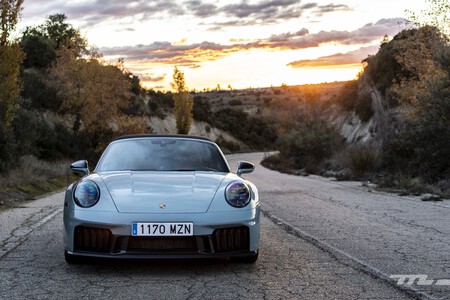
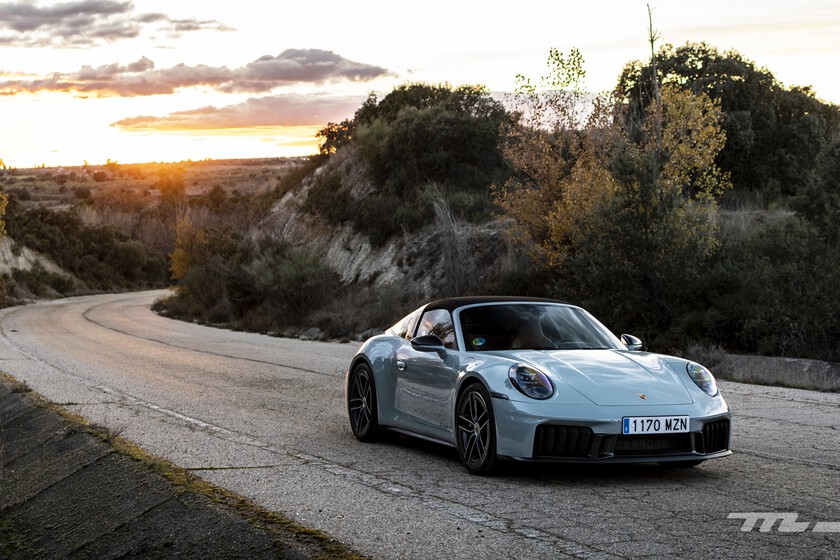
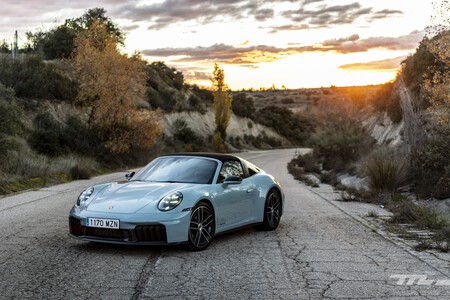
This 911 with the Targa GTS specification is style made into a car. Right from the start, the silhouette of the Targa body is incredibly beautiful. There are very few cars today that can afford to wear such a model.
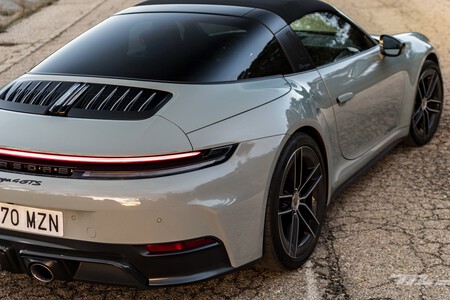
By the way, the roof folds electronically and disappears completely between the glass and the engine cover. A operation that takes a bit longer than we’re used to, where it seems style equals a race. It isn’t.
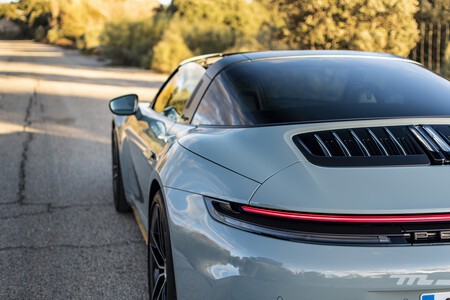
The pronounced arc formed by the B pillar and the roof’s drop toward the rear accentuates the classic figure that defines the 911, taking it one step further into the world of iconic and timeless cars. Even more so in the spectacular Verdant Green Metallic color. The carbon-fiber details on the wheels, front and rear bumpers, and mirrors give it an extra touch of exotic sportiness.
But it’s true carbon fiber. No fake materials, nor an imitation of something, nor unnecessary frills hidden behind aerodynamic theatrics. It doesn’t even have the air intakes on the rear wheel arches like its bigger siblings.
Sure, it may lack the brutality of the Turbo or the nostalgia of the Cabrio, but the combination of a classic-hued color with the Targa body that remains faithful to the main lines of the 911 makes it especially appealing.
And that, in a car that is absolutely unmistakable, is a lot to say, because the shape of the 911 is unique to the 911 (well, a bit to the 718 Cayman/Boxster). It preserves that low and flat front with bulging headlights, the curved profile, and the utterly rounded rear.
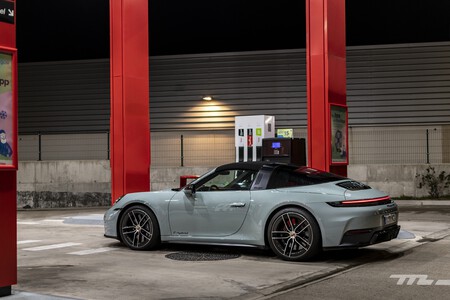
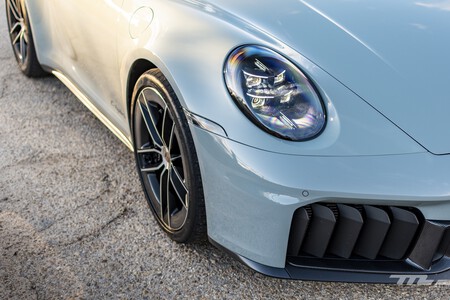
In the front, what draws the most attention are the side air intakes with five active vertical blades characteristic of this generation. They open and close as needed to regulate airflow and they give a distinct presence to an area that is usually dominated by horizontal lines.
The wheels on this unit were the Exclusive Design 20 and 21 inches in front and rear respectively, in two tones and with carbon-fiber blade inserts that improve aerodynamic efficiency. Their price: 1,011 euros.
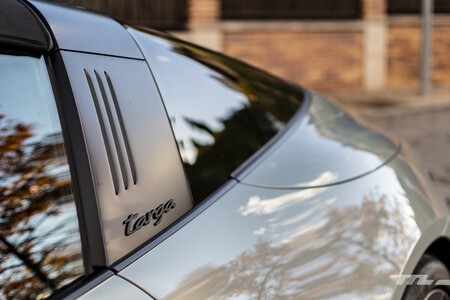
The bulk of the visual weight is in the rear half, where the engine is hidden but clearly present with its signature air outlets on top, the model name clearly visible, and a diffuser that I found surprisingly discreet with two exhaust outlets in the center.
And this is perhaps the best part of the exterior of this 911. It’s spectacular because it is pure. Striking in its appeal but simple in its lines. There are no huge wings, no canards, no exaggerated diffusers. That, precisely that, is a 911.
Outside this Porsche 911 is beautiful. Inside, more
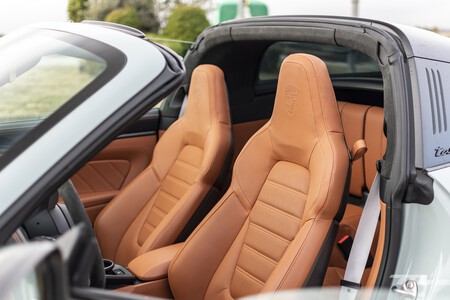
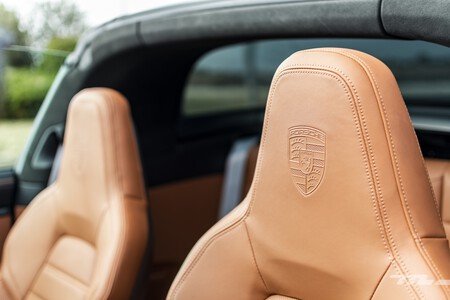
I get the same feeling of “I wouldn’t configure it this way at all,” but the pairing of classic lines, modern technology, ergonomics, and brown leather upholstery breaks the mould. The brown and black blend very harmoniously and this interior shade is the perfect match for the exterior paint color.
The driving position is quintessentially 911. The seat sits very low, as it should, with the dashboard relatively high and the steering wheel close. A classic three-spoke steering wheel from the brand with simple lines and a thick, compact rim.
Behind there is a 12.6-inch screen that takes over all functions. There is no longer any analog display, even though it simulates a gauge cluster with five dials.
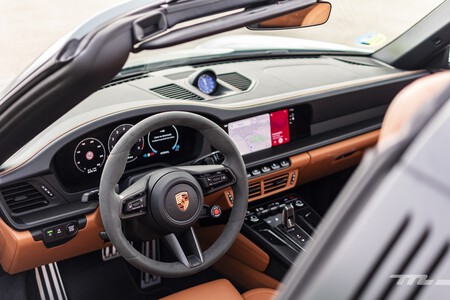
With a 10.9-inch screen with Android Auto and Apple CarPlay the infotainment dilemma is solved, offering a clean, fast interface that avoids unnecessary frills so you can focus on what truly matters: driving and enjoying the moment.
If you want a touch more accompaniment and you’re a music aficionado, you can choose between two optional sound systems: Bose (€1,676) or Burmester 3D (€5,315).
At the rear there is space, supposedly for two people. Normally the 911 is a two-seater but if you want a 2+2, you can order the rear seats at no extra cost. I see the utility, but not the necessity.
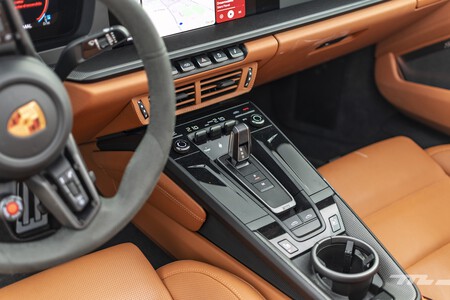
The materials are exquisite, and every piece feels meticulously crafted, forming an interior that won’t be the most comfortable, but I assure you you’ll not want to get out for all it has to offer.
With the roof closed there are no audible noises or isolation issues. It’s a thick, rigid canvas. With the Targa roof open the story changes and you get a constant air flow that may not be the most comfortable, but it’s well worth the experience of hearing this engine climb the revs through the curves.
As for trunk space we’re limited to a single compartment under the front hood of 135 liters. You can fit a couple of carry-on suitcases or your weekly shop for a single person.
The first hybrid 911 in history without losing its essence
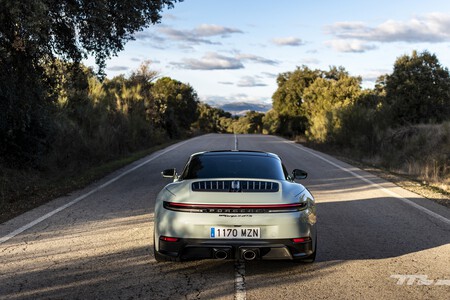
Leaving aside the body, the GTS variant is perhaps the most balanced. It sits above the Carrera, Carrera 4S, Carrera T, Carrera S and Carrera GTS, yet below the Turbo, Turbo S, GT3, GT3 Touring and GT3 RS.
In contrast with the exterior, which might seem the least techy, the powertrain makes this Carrera GTS the most advanced of its time (aside from the new Turbo T-Hybrid), because it’s the first 911 to be equipped with electrification. Because yes, besides everything, it also carries an ECO label from the DGT. It’s the first electrified 911.
The engine maintains the six-cylinder boxer configuration 3.6 liters with a turbo that forces gasoline into the engine. It’s 0.6 liters more than the previous GTS and one less turbo. Specifically, a turbo with electric actuation.
The turbine doesn’t spin purely on exhaust gas thrust to push the air intake; it’s driven by an electric motor that suddenly eliminates turbo lag. Isolated figures running on gasoline alone are strong: 485 hp at 6,500 rpm and 570 Nm between 2,000 and 5,500 rpm.
This electric motor can work in reverse and, during deceleration phases, acts as a generator that recovers energy and channels it to a small 1.9 kWh battery placed on the front axle to improve weight distribution. It stores energy that goes to a second electric motor that, in this case, sits inside the eight-speed dual-clutch PDK transmission.
This electric motor produces 54 hp (peaking up to 64 hp for 10 seconds) and 150 Nm, and when added to the gasoline engine output, total 541 hp and 610 Nm. In no scenario can this 911 Targa 4 GTS be moved in 100% electric mode.
In total the GTS gained 61 hp more when switching to hybrid technology, but it also gained 50 kg in weight to a total of 1,670 kg, of which 23 kg are from the second battery.
All told, the system delivers 541 hp and 610 Nm of torque. Solid figures and a better-sounding note, which caps off a drivetrain as distinctive as it is unique in the market. That dry, deep rumble has something special.
After all this rambling, I can tell you that this 911 Targa 4 GTS is a car with an exceptional shove that is linear and forceful from very low revs. You can feel the turbo lag being suppressed by electric assist and accelerations are brutal.
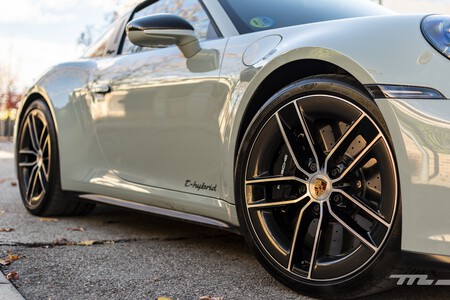
This effect is partly due to the use of the dual-clutch PDK gearbox, which is one of the best out there in the motor world. I’ve known it for its efficiency and superb shift management without losing emotion, with barely perceptible gear changes.
The figures say 0-100 km/h in 3.1 seconds, and a top speed of 312 km/h if you’ve got a good Autobahn ahead of you or a track. What they don’t tell you are the sensations, and even though there’s an ECO label on the windshield, I assure you the feel is that of a car with an impact that does not fade.
The kick, the way it climbs through the revs, the harsh sound of the boxer, the feel of the shift tapping the paddles if you’re in manual mode… If you tried it blindfolded, it would be very hard to tell it’s ECO. Even more so with the roof up.
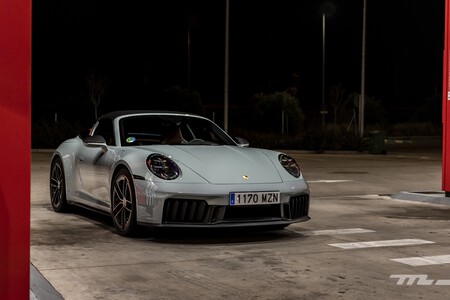
All this is complemented by a chassis that’s difficult to explain in words. On paper, anyone would tell you that this recipe should not work with the engine mounted so far back. Anyone who doesn’t know that it’s a 911 and a recipe that has worked for 60 years. And even before the 911, with the Porsche 356, they did it.
The great novelty of this generation is that the GTS uses a chassis with many aids, supported by the high-voltage system of the hybrid layout. The most relevant are the Porsche Dynamic Chassis Control (PDCC) with active anti-roll bars and the rear-steer axle.
Although the engine has grown displacement (with more stroke and bore), the mark claims it sits 110 mm lower, reducing the center of gravity height by a critical point that translates into even better dynamic behavior. As if that weren’t enough, it also features a rear-steer axle that the previous models did not have.
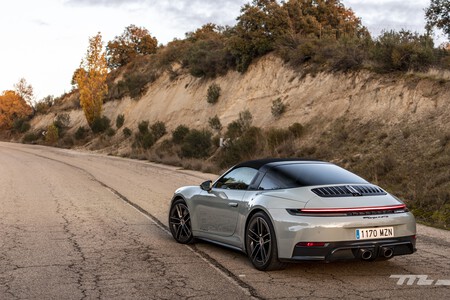
This gives us a sense of agility and precision that is even better in something that was already hard to improve. The commands we give to the wheel are translated into lines traced with a compass and a high degree of feedback about what’s happening at the wheels.
It’s a car that feels a notch sharper than the lower variants, but without the excessive push of the newer Turbo versions I tested a few months ago. It’s balance, and it makes that known. And when a car tells you that, you can only surrender and enjoy.
Porsche 911 Targa GTS T-Hybrid: the price of history
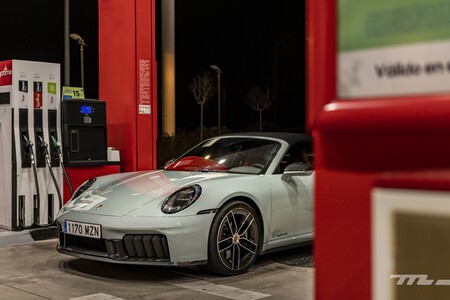
The Porsche 911 is not just a halo car for a brand. It’s an identity marker. There are few names in the industry that can compete with the grandeur of just three characters.
Saying 911 implies a standard that places heavy pressure and responsibility on the brand. That’s why every change is studied under a microscope, and that’s why they decided the electrification of their icon would be done in a very special, unique, and respectful way to its legacy.
All of this means every decision is for and about the Porsche 911, and that has led this 911 Targa GTS to cost what it costs. It starts at €206,201, but adding options and probably leaving you with a few more by the time you’re done, this unit sits around €230,000.
It is an exclusive car and it makes that clear from its price, but spend time with it and you realize there’s a justification. Just like its consumption, because far from being a hybridization designed to save fuel, it has been conceived for sensations.
It homologates a consumption of 10.8 liters per 100 km, and in our test we ended up with 15.2 liters per 100 km. No, it’s not a frugal car. Yes, we enjoyed it. A lot.
Porsche 911 Targa GTS T-Hybrid 2026 – Assessment
7.9
9
8
9
6
6
10
8
9
8
6
Strengths
- 911 purity
- Emotional electrification
- Brisk-sounding engine
- A chassis of its kind
Weaknesses
- High consumption
- You have to pay what it costs
The Porsche 911 is an icon. In the Targa version, even more so. And if you look closely, there are very few, almost no units with this body configuration on the street. That adds a further level of exclusivity.
With this sublime spec it’s hard not to linger, even if only to stare for a while, but once you start it the fascination is instant.
If there are cars with soul, this is certainly one of them.
Porsche 911 Targa GTS T-Hybrid 2026 – Technical specifications
|
Porsche 911 Targa GTS T-Hybrid |
||
|---|---|---|
|
Internal combustion engine |
||
|
TYPE |
Six-cylinder boxer |
|
|
DISPLACEMENT |
2,981 cc |
|
|
MAXIMUM POWER |
480 hp at 6,500 rpm |
|
|
MAX TORQUE |
570 Nm at 2,300 – 5,000 rpm |
|
|
TRANSMISSION |
Seven-speed automatic |
|
|
DRIVETRAIN |
All-wheel drive |
|
|
dimensions |
||
|
LENGTH |
4,533 mm |
|
|
WIDTH |
1,852 mm |
|
|
HEIGHT |
N/A |
|
|
WHEELBASE |
2,450 mm |
|
|
WEIGHT |
1,725 kg |
|
|
TRUNK CAPACITY |
123 liters |
|
|
Performance and consumption |
||
|
0-100 KM/H |
4.3 seconds |
|
|
TOP SPEED |
307 km/h |
|
|
OFFICIAL FUEL CONSUMPTION |
10.8 l/100 km |
|
|
TEST FUEL CONSUMPTION AVG |
15.2 l/100 km |
|
|
price |
€206,201 |
The car for this test was provided by Porsche Ibérica. For more information, consult our guide to relationships with companies.