
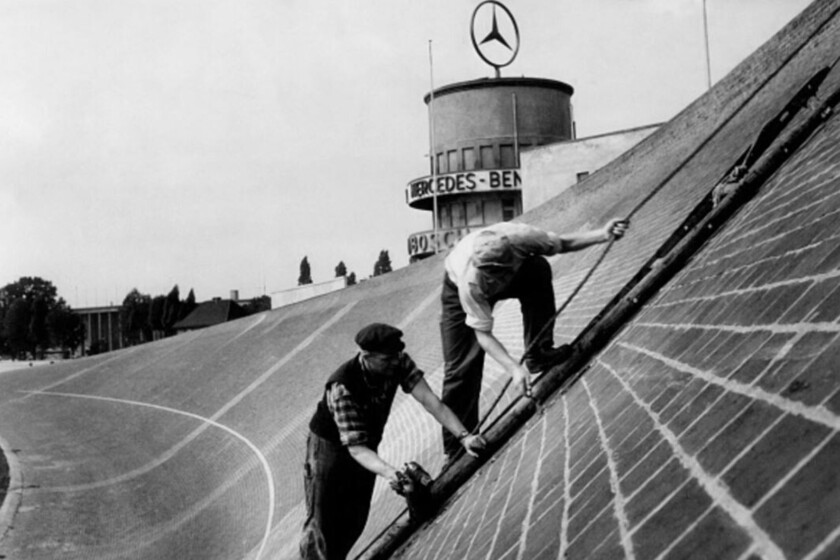
On the outskirts of Berlin, beside one of its busiest highways, lie the remnants of one of the most unusual circuits in the history of motorsport: AVUS. Today its route goes largely unnoticed, but in its day it was the fastest and most audacious track in the world, the stage for great milestones as well as tragic accidents.
With two endless straights joined by a fork and a banked curve so extreme that it earned the nickname “the wall of death,” AVUS defined an era of unparalleled speed. But what made it so special, and why did it become a legendary circuit?
The Birth of AVUS: The First Highway Turned into a Circuit
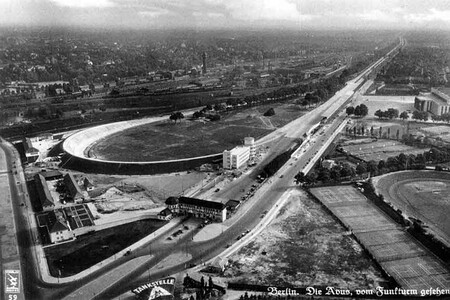
AVUS (Automobil-Verkehrs und Übungsstraße, “Car Traffic and Automobile Training Road”) began to take shape in 1907 as an experimental route for the German automotive industry. However, its construction was delayed by World War I, and it was not until 1921 that it was officially inaugurated. It was an extremely simple design: two parallel straights of almost 10 km joined by cambered curves.
The circuit served as a toll road between Berlin, Wannsee and Potsdam when it wasn’t used for competitions, thereby becoming the first highway in modern history. Yet its true fame arrived with high-speed races, which attracted the most prestigious manufacturers and the bravest drivers of the era.
From its early Grand Prix events in the 1920s, AVUS proved to be a circuit as fascinating as it was dangerous. In 1928, Fritz von Opel set a record by reaching 238 km/h in his Opel RAK2, powered by 24 solid-fuel rockets.
However, the great transformation arrived in 1936, when the north curve was rebuilt with a camber of 43.6 degrees, double the incline of Daytona or Indianapolis.
With this modification, AVUS became the fastest circuit in the world. In 1937, Hermann Lang, driving a Mercedes W25K-M125 with aerodynamic bodywork, achieved a race-average speed of 260 km/h, a record that stood for decades.

Rudolf Caracciola, aboard a Mercedes W125, reached 438 km/h in 1938, a mark that remained unbeaten on closed circuits for many years. From that day he earned the nickname “Master of Rain”.
The Tragedy and Decline of AVUS: The World’s Fastest Circuit
Beyond its flashes of glory, AVUS also carries a dark legend, for the track’s extreme speed and characteristics brought several tragedies. One of the first occurred in 1933, when Otto Mertz died after losing control of his car in the rain.
Later, in 1938, driver Bernd Rosemeyer died attempting to beat the land-speed record. And in 1959, during an event preceding the German Grand Prix, Jean Behra lost his life in the banked curve after a brutal crash.
These and many other incidents, coupled with advances in safety and the growth of traffic in the area, led to AVUS’s gradual disappearance as a circuit. In 1967, the north curve was demolished and replaced by a flat version. In the 1970s, only two races were held per year, until in 1999 AVUS was definitively no longer used for competition.
Today, what remained of the AVUS circuit is part of Berlin’s A-115 Autobahn. However, you can still find some of its original grandstands and catch glimpses of its emblematic infrastructure, reminding visitors of the glory and danger of this legendary layout.
AVUS was more than a circuit; it was the setting for some of the fastest and most terrifying moments in the history of motorsport. An irreplaceable place, marked by audacity and tragedy, that continues to inspire admiration among motor enthusiasts.
Imágenes | Berlin.De