
You may like electric cars more or less, or not at all, but there are some you should really try if you ever get the chance. Seriously. They might change the way you see electric vehicles.
I’m telling you this because the Porsche Taycan may surprise you more than you think: it’s far more than a plain electric sedan. It embodies the sportiness as Porsche understands it, applied to electric mobility, and I assure you it’s worth at least giving it a chance.
Porsche Taycan GTS: far more than a dad car

A four-door sedan under five meters in length might seem ordinary. Or not. It depends on how you look at it.
And the Taycan is a car that plays in a space we could call neutral or perhaps undefined, because in length it’s almost as long as a Panamera, but it obviously doesn’t rival it for one simple reason: its interior feels noticeably less spacious.
But understand me, I don’t mean this as a criticism of being externally compact with a poorly utilized interior. Not at all. It means it represents a different philosophy that doesn’t aim to outrun its gasoline-powered cousin.
In its favor, the premises are clear: it aims to be a sporty electric sedan with all that implies, and it wears the Porsche badge proudly, distinguishing it as Porsche.
The Taycan is a car we’ve driven in a wide range of variants, but now we wanted to take advantage of its recent facelift to test what, from my point of view, seems to be the most balanced option: the Taycan GTS.
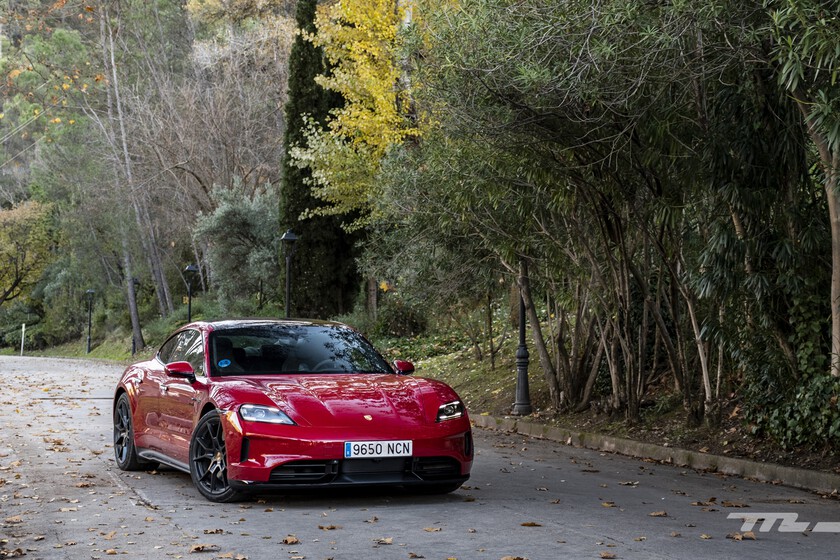
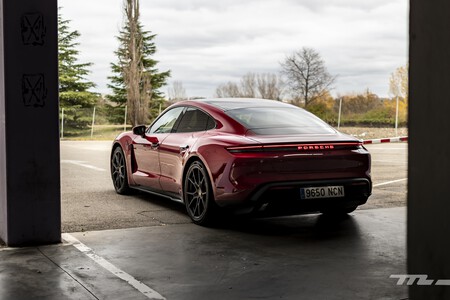
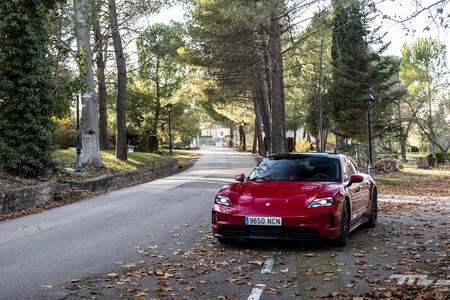
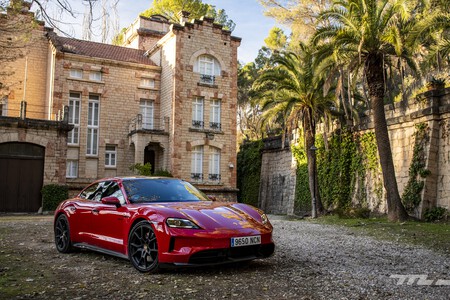
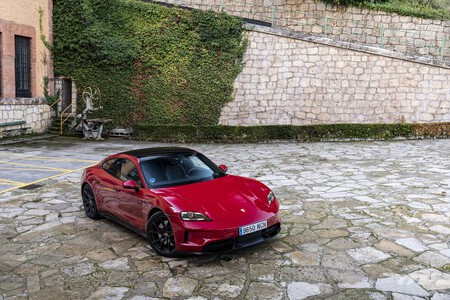
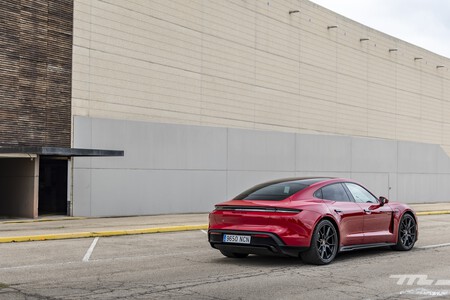
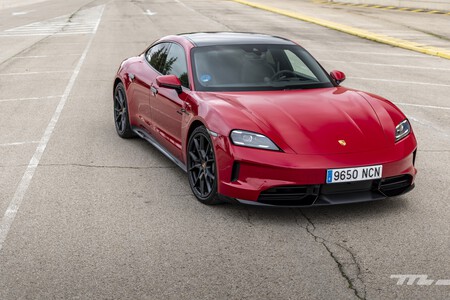
Before getting into dynamic spoilers, I can tell you that the Taycan retains its identity with that exterior as unmistakably Porsche and with a silhouette that is very sleek. With 4.9 meters in length and a height of only 1.38 meters, along with the car’s muscular curves, this Taycan looks spectacular. Even more so in this intensely red color with black exterior elements.
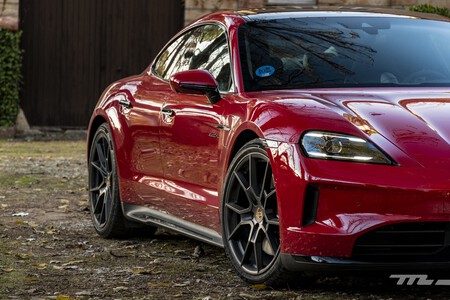
It’s no surprise, because the Taycan, more than a smaller Panamera, wants to be identified as a four-door 911. Look at the roofline sweeping back and how it falls toward the rear. Or at those voluptuous wheel arches. Or the new, more aggressive front lights.
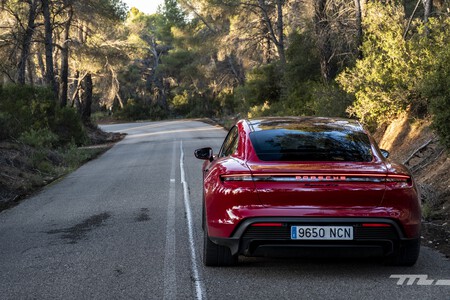
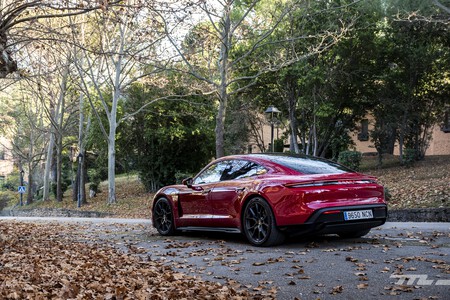
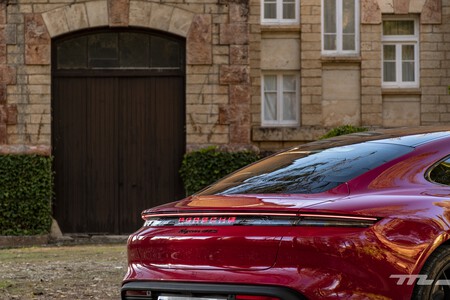
From the rear, the trunk is crowned by a retractable spoiler and a light signature that runs side to side with the PORSCHE letters illuminated in the center, giving it a very techy look.
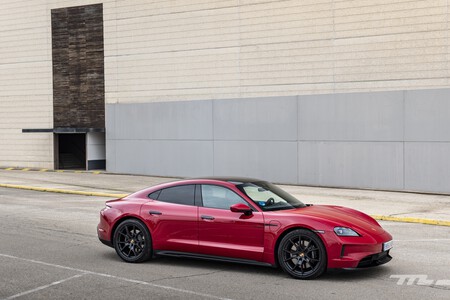
A design that, in my view, I like a lot, and although it doesn’t pretend to use fake exhaust outlets to simulate something they aren’t, it does have subtle tricks to add drama to the bodywork, like air outlets sealed behind the front wheel arches.
We can fault electric mobility on many counts, but one thing is clear: Porsche has made the Taycan a direct reply to those who say electric cars are all the same and ugly. I think it’s one of the most beautiful electric cars you can buy.
Porsche language without leather (if you don’t want it)
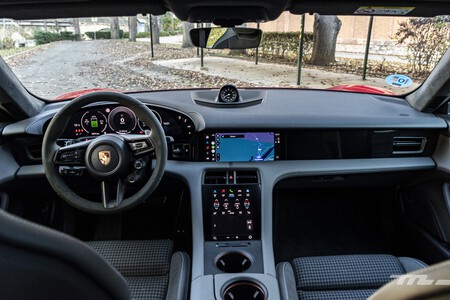
The Taycan’s interior is similar to that of other Porsches but follows a different philosophy. Recently we saw in the new Panamera that some functions are kept via a physical interface. Not here.
When the Taycan debuted in 2019, it did so with a very modern presentation, and back then modernity leaned toward integrating all functions through screens. This meant the climate controls moved into another screen tilted in the center console. In this facelift, that remains.
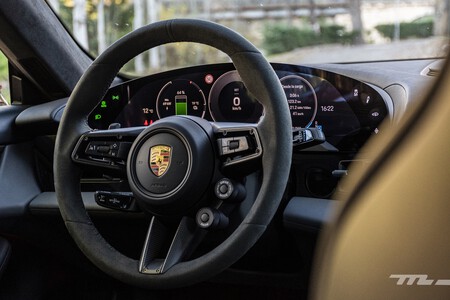
And the interior is fully digital. The instrument cluster, with no sunshade, presents a Porsche-style dial aesthetics with meticulously crafted, minimalist graphics that are perfectly legible—except that the screen is wider than the steering wheel, and the steering wheel frame partly covers it.
In the center there’s an infotainment screen that is well integrated and not oversized like some rivals, but it stands out for its smooth operation and carefully crafted user experience. It is obviously compatible with wireless Android Auto and Apple CarPlay. In front of the passenger there is also another screen, just in case.
But as I mentioned, all interactions are performed through non-physical buttons; either on the screens or on the digital buttons around the instrument cluster that let you adjust the car’s ride height, lights, suspension modes, disable driver aids… The gear selector is also mounted to the dash. And yes, I would still prefer the traditional physical buttons. They provide feedback and a nicer feel when using them.
On the far end we find the steering wheel with a setup very similar to other models, with physical controls and pleasant to use for certain functions, plus two satellite buttons for driving modes and PASM.
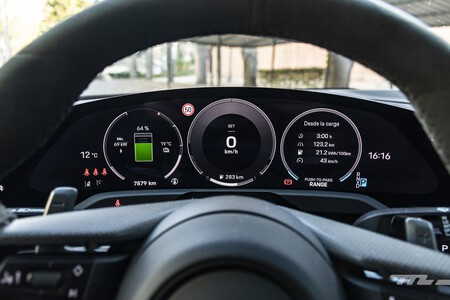
Otherwise the steering wheel features carbon fiber inserts, a round Alcantara-covered rim, and paddles. I liked it a lot both in feel and the information it conveys, though we’ll return to that later.
The rest of the cabin is almost unchanged, notable for superb fit and top-tier quality with one small but: the pleated plastic that covers the interior. It’s good plastic and pleasant to touch, but it is plastic. The simple solution is to order it with leather, which Porsche offers at no extra cost for those who want it.
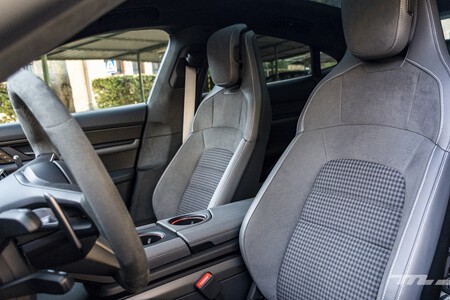
The front seats have a distinctive GT-style setup with a comfortable bucket frame and floating headrests. They are fully electric and provide fantastic support without sacrificing comfort. They are firm and comfortable at the same time, and the sensation of sitting very low to the floor is present throughout.
Rear seats do not come close to the space of a Panamera due to pure size limitations. It’s neither as large nor does it offer the same amount of floor space, because the Taycan must leave room for the batteries. Porsche has addressed this with an irregular battery floor to provide more foot space. Still, it’s a car that remains comfortable, and at 170 cm tall I still have headroom.
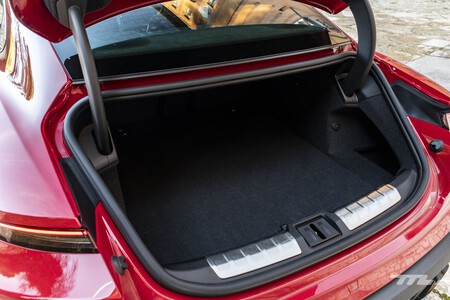
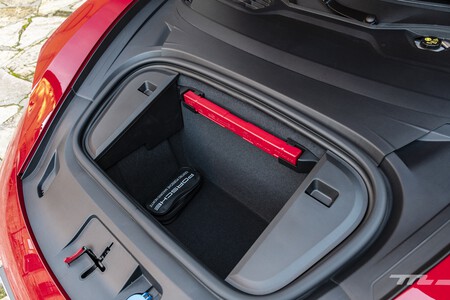
And finishing with the interior, we move to the trunk, which, like any electric car, comprises two storage spaces: a rear trunk with 366 liters plus 84 liters in the front. It isn’t exactly generous, but that’s the price to pay for chasing sportiness.
Tan rápido como los neumáticos le permiten
In this unit we had what is likely the most interesting chassis upgrade for the Taycan to date. Active Ride is something we’ve previously tested on the Panamera Turbo S E-Hybrid, and it left a very good impression. It feels similarly effective here in the Taycan.
Traditional anti-roll bars and springs are replaced by air springs and hydraulic elements connected to a 400V system.
The interesting thing about this complex system is that it can generate up to 1,000 kg of vertical force per axle and, managed in milliseconds, it can neutralize or even counteract body roll during acceleration, braking, or cornering. Yes, it can even make the body lean into the inside of a turn.
This system, combined with the superb chassis developed by Porsche at the front and a very low center of gravity, makes the Taycan GTS’s dynamic behavior excellent and, surprisingly, emotional.
Contributed by a precise, responsive steering feel and the trick of the rear-wheel steering. It shifts from feeling like a big car to a nimble, precise one if you want it to be, delivering flat cornering in most situations despite weighing over 2,300 kg. And the best part is that it doesn’t feel harsh or bouncy.
This option isn’t cheap, but it’s very interesting for enhancing the driving experience because it turns a fast car into a fast and highly enjoyable one.
And it’s fast. Very fast. Because it can be, here, equipped with a 105 kWh (97 kWh usable) battery system operating at 800V with a maximum charging power of 320 kW.
The motor layout is also different from the norm, because Porsche can afford it. It combines a front induction motor with a rear permanent-magnet motor and a two-speed automatic gearbox plus a limited-slip differential. The rear motor has received software and hardware updates in this evolution.
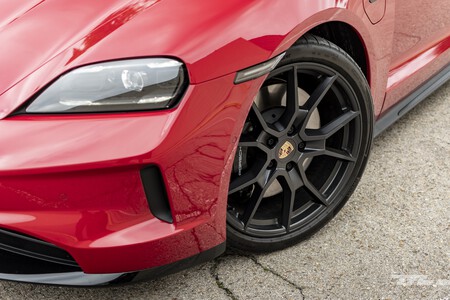
In total they offer 700 HP of peak power (slightly lower in normal use) and 790 Nm of torque that push a massive amount of speed, where the limits of converting all that power into velocity depend on tire grip. And even in standard form it runs on 245 and 285 wide tires at 20-inch wheels… and the unit we tested wore even larger ones.
From a standstill, acceleration is instantaneous, but in recoveries it’s almost exaggerated. There is zero delay in power delivery, and the speed builds so suddenly that you’d better keep your head resting on the seat.
The chassis and the motor work in harmony and it feels like a surgical precision, where the tire dampening is excellent and the resistance when pushing through corners is even better. Like the acceleration, the limit is set by the tires.
The trade-off for being an emotional, incredibly enjoyable electric car is its efficiency. At the end of our test, the Taycan GTS delivered a consumption of between 20 and 21 kWh/100 km, which is high, but Porsche has introduced numerous small changes to improve its range.
Still, the range remains the weak point of these cars, and in real-world use without fully draining the battery, you can expect around 350 km. The good news is that charging at 800V brings back about 80% of the battery in under 20 minutes.
The brakes are the typical ones you’d expect on a car of this power and size, with discs of 390 and 358 mm with six- and four-piston calipers, performing very well under normal conditions, with a very good feel and regenerative braking adjustable, though I did encounter a strange point.
I’ve driven it in both favorable and adverse conditions, and while on good dry asphalt the braking felt excellent, on slightly slippery surfaces I detected a bit of imprecision in the braking. As if there were a progressivity step between mechanical braking and regeneration, and the wheels occasionally slipped under normal driving. This might also be related to the use of summer performance tires.
Porsche Taycan GTS: the best experience costs
Placed in the context of its rivals, it can be compared with other high-performance electric sedans such as the Audi RS e-tron GT, the Lotus Emeya, the Mercedes-AMG EQE 53 4MATIC+, or the Tesla Model S Plaid.
All of them are cheaper with similar power figures, even the Audi at 856 HP costs a little less using exactly the same battery, and the Tesla is the cheapest of them all on the street. The big difference is that, pending a proper test of the Lotus, I’d say the Porsche has the best chassis and the best driving experience of the group, the most visceral feel, and the most refined interior—better even than the Mercedes and infinitely better than Tesla’s.
In short, it’s one of those electric cars I would buy for its performance, ride quality, handling, and because, without a doubt, it is very, very beautiful. Luckily, making that kind of decision isn’t a problem for me because—at least with this month’s paycheck.
Porsche Taycan GTS 2026 – Valoración
7.9
8
8
9
8
7
9
8
8
7
7
Pros
- Electric emotion
- Excellent dynamic behavior
- Porsche quality
Cons
- Heavy weight
- Not affordable for everyone
- A somewhat more elaborate center console would be nice
Porsche made a great bet with the Taycan. Instead of following the fashion of most manufacturers, it went all-in on a car for electric sedans, a vehicle that broke molds when it arrived in 2019.
Now it has its first major update and, although inside it seems not to have changed much, there has been a major technical advance and, for the first time, I’ve been able to test it in GTS form.
And if it was something I suspected in combustion models, with this fully electric Taycan GTS it has happened again: the GTS version has the best balance between performance and dynamics, in addition to offering reasonable range.
Porsche Taycan GTS 2026 – Ficha técnica
|
porsche taycan gts test |
||
|---|---|---|
|
Motorización |
||
|
TYPE |
Two electric motors |
|
|
DRIVE |
All-wheel |
|
|
TOTAL POWER |
515 kW (700 HP) |
|
|
MOTOR TORQUE |
790 Nm |
|
|
TRANSMISSION |
Automatic |
|
|
BATERy |
||
|
GROSS CAPACITY |
105 kWh |
|
|
NET CAPACITY |
87 kWh |
|
|
RANGE |
630 km |
|
|
RECHARGE POWER |
320 kW |
|
|
Dimensions |
||
|
LENGTH |
4,963 mm |
|
|
WIDTH |
1,966 mm |
|
|
HEIGHT |
1,381 mm |
|
|
WHEELBASE |
2,800 mm |
|
|
WEIGHT |
2,370 kg |
|
|
TRUNK CAPACITY |
366 + 84 liters |
|
|
Performance and consumption |
||
|
0-100 KM/H |
3.3 seconds |
|
|
Top speed |
250 km/h |
|
|
Homologated consumption |
18 kWh/100 km |
|
|
Average test consumption |
20.7 kWh/100 km |
|
|
Price |
154,159 euros |
The car used for this test was loaned by Porsche. For more information, consult our guide to corporate relationships.